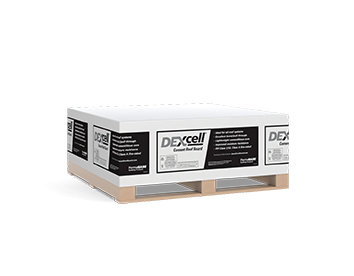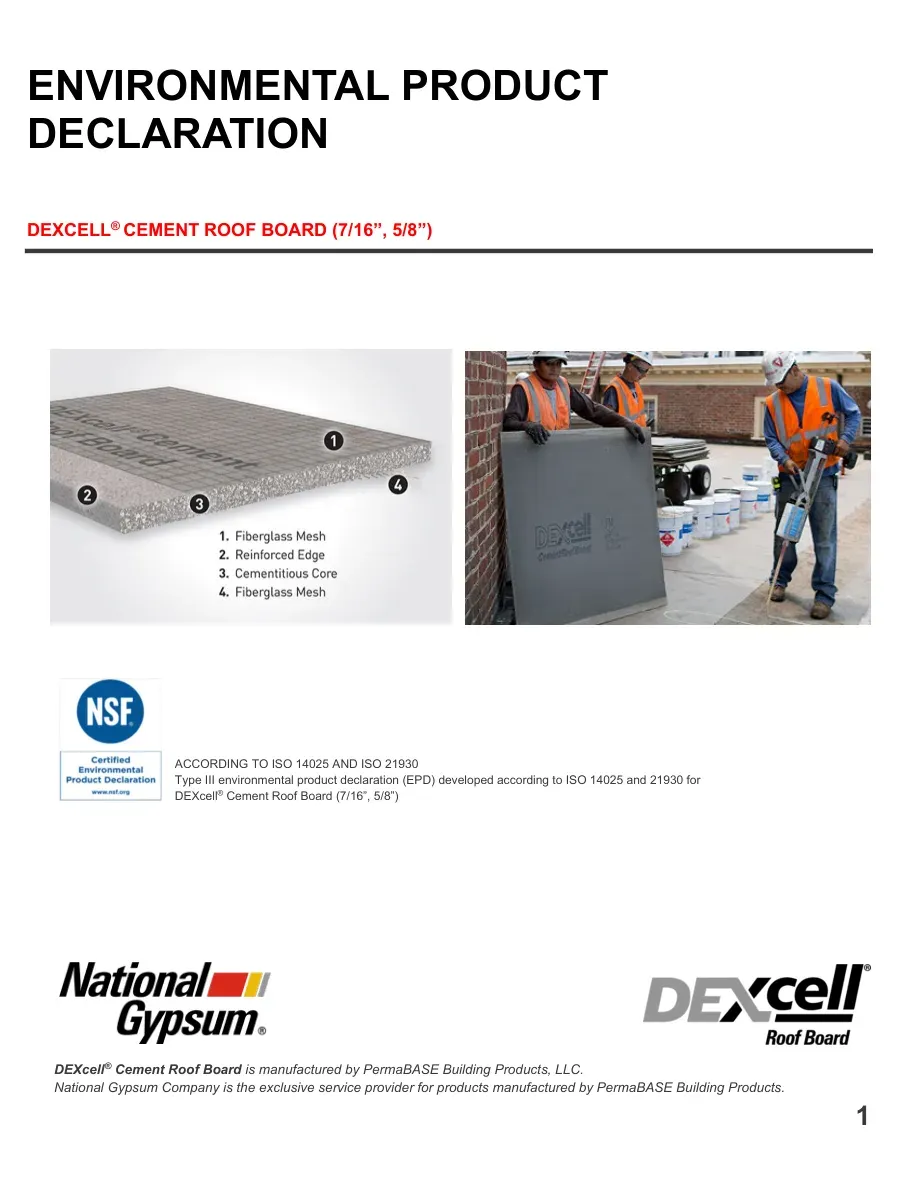
1 ENVIRONMENTAL PRODUCT DECLARATION DEXCELL® CEMENT ROOF BOARD (7/16”, 5/8”) ACCORDING TO ISO 14025 AND ISO 21930 Type III environmental product declaration (EPD) developed according to ISO 14025 and 21930 for DEXcell® Cement Roof Board (7/16”, 5/8”) DEXcell® Cement Roof Board is manufactured by PermaBASE Building Products, LLC. National Gypsum Company is the exclusive service provider for products manufactured by PermaBASE Building Products.
2 Program Operator NSF Certification LLC 789 N. Dixboro, Ann Arbor, MI 48105 www.nsf.org Manufacturer Name and Address PermaBASE Building Products, LLC 2001 Rexford Road Charlotte, NC 28211 Declaration Number EPD11020 Declared Product and Declared Unit 92.9 m2 (1,000 square feet) of DEXcell® Cement Roof Board (7/16”, 5/8”) Reference PCR and Version Number ISO 21930:2017 Sustainability in buildings and civil engineering works - Core rules for environmental product declarations of construction products and services. Product’s Intended Application and Use Products are designed to be used in a variety of roofing systems including fully adhered, mechanically attached, and ballasted roofs using single-ply membranes, modified bitumen, fluid applied, built-up roofing, spray foam, and metal. Product RSL Lasts lifetime of the roof Markets of Applicability North America Date of Issue 01/31/2025 Period of Validity 5 years from date of issue EPD Type Product Specific Range of Dataset Variability N/A EPD Scope Cradle-to-Gate Year of reported manufacturer primary data 2022 LCA Software and Version Number GaBi 10.0.0.71 LCI Database and Version Number GaBi Database 2023.2 LCIA Methodology and Version Number TRACI 2.1 and IPCC AR6 The sub-category PCR review was conducted by: • Thomas P. Gloria, Industrial Ecology Consultants • Bill Stough, Sustainable Research Group • Jack Geibig, EcoForm This declaration was independently verified in accordance with ISO 14025: 2006. ISO 21930:2017 serves as the core PCR. Internal External Jack Geibig – EcoForm jgeibig@ecoform.com This life cycle assessment was conducted in accordance with ISO 14044 and the reference PCR by: Maggie Wildnauer, WAP Sustainability Consulting, LLC This life cycle assessment was independently verified in accordance with ISO 14044 and the reference PCR by: Jack Geibig – EcoForm jgeibig@ecoform.com Limitations: Environmental declarations from different programs (ISO 14025) may not be comparable. Only EPDs prepared from cradle-to-grave life-cycle results and based on the same function, reference service life, and quantified by the same functional unit, and meeting all the conditions in ISO 14025, Section 6.7.2, can be used to assist purchasers and users in making informed comparisons between products. Full conformance with the PCR for Products allows EPD comparability only when all stages of a life cycle have been considered. However, variations and deviations are possible. Example of variations: Different LCA software and background LCI datasets may lead to differences results for upstream or downstream of the life cycle stages declared. Additional information on the life cycle assessment can be found by contacting National Gypsum directly.

3
4 DESCRIPTION OF COMPANY National Gypsum Company is the exclusive service provider of reliable, high-performance building products manufactured by its affiliate companies and marketed under the Gold Bond®, ProForm®, and PermaBASE® brands. The National Gypsum name has been synonymous with high-quality, innovative products and exceptional customer service since 1925. PRODUCT DESCRIPTION DEXcell® Cement Roof Board is a lightweight, moisture- and mold-resistant panel that provides an exceptionally hard, durable surface that withstands prolonged exposure to moisture. Its composition of Portland cement and lightweight aggregate with heavy-duty fiberglass-mesh facers makes it an excellent fire and thermal barrier. This moisture- and mold-resistant cement panel is a substrate board, thermal barrier, and coverboard for commercial roofing applications. DEXcell® Cement Roof Board complies with ASTM C1325 Standard Specification for Fiber-Mat Reinforced Cementitious Backer Units. Use it for a wide variety of roofing systems, including fully adhered, mechanically attached, and ballasted roofs using single-ply membranes, modified bitumen, fluid-applied, built-up roofing, spray foam, and metal. As a coverboard in roofing assemblies, DEXcell® Cement Roof Board protects and supports the roof membrane; provides increased fire, moisture, and mold resistance; and reduces the potential for penetration damage to the membrane. It can also be used to sheathe the roof side of parapet and penthouse walls and is ideal for green roofs and photovoltaic systems. Product Features: • Excellent bond/pull-through/uplift values. • Impact-resistant, extremely durable, and dimensionally stable. • High compressive strength. • Lightweight, cementitious core. • Superior moisture resistance. • Exceptional freeze/thaw resistance. • Scores and snaps easily. • Meets ASTM C1325. • Meets UL Class 1 and UL Class A fire ratings for roofing systems up to unlimited slope per UL 790 and ULC CAN-S107. • Use in accordance with a rated system, and DEXcell® Cement Roof Board provides a thermal barrier meeting IBC Section 2603. • Resists the growth of mold per ASTM D3273 with a score of 10, the best possible score. This EPD includes representative products manufactured by National Gypsum’s affiliate, PermaBASE® Building Products and Unifix, Inc., produced at the facilities shown in the table below. The facilities shown below produce DEXcell® Cement Roof Boards in all thicknesses covered under this study: 7/16” and 5/8”. A weighted average of each manufacturing input (energy, water, waste, etc.) was utilized based on 2022 production as products are made at multiple facilities.
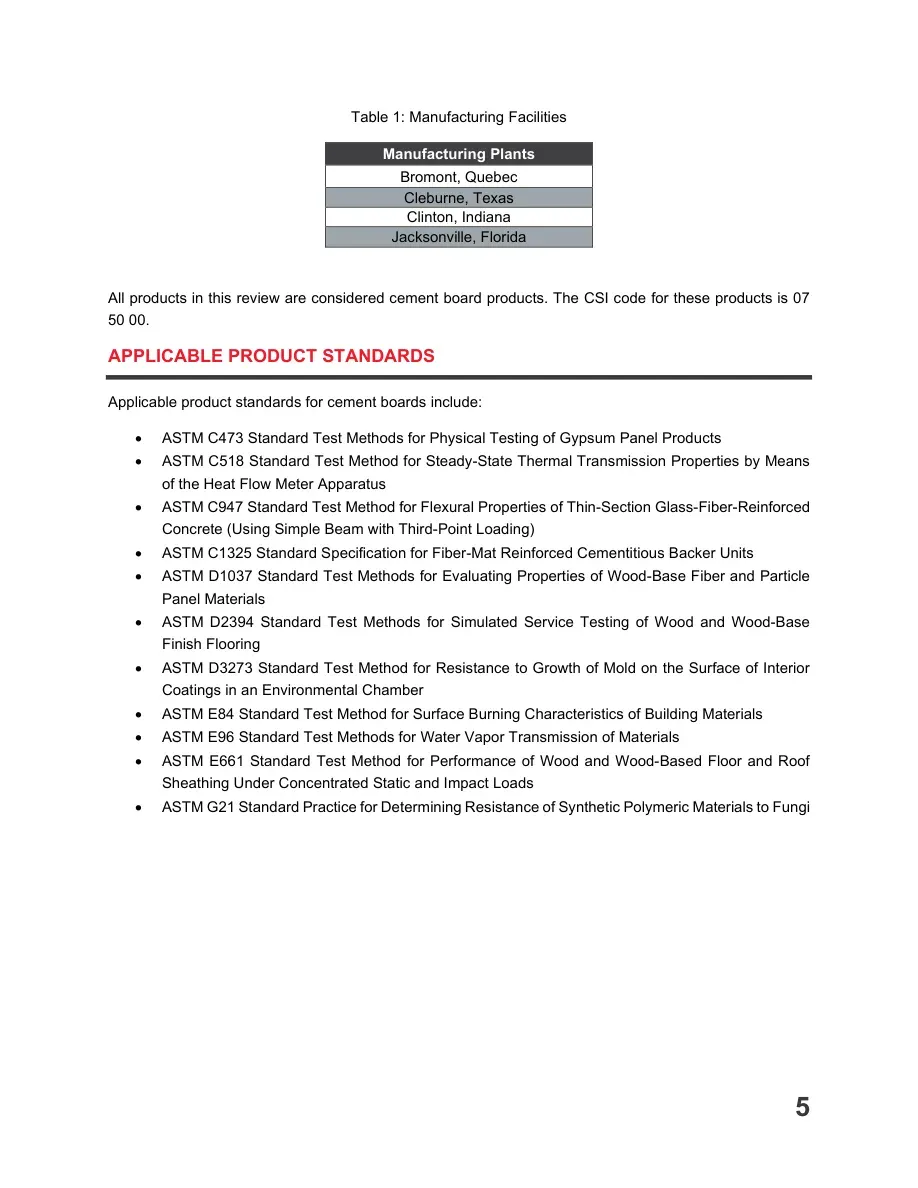
5 Table 1: Manufacturing Facilities Manufacturing Plants Bromont, Quebec Cleburne, Texas Clinton, Indiana Jacksonville, Florida All products in this review are considered cement board products. The CSI code for these products is 07 50 00. APPLICABLE PRODUCT STANDARDS Applicable product standards for cement boards include: • ASTM C473 Standard Test Methods for Physical Testing of Gypsum Panel Products • ASTM C518 Standard Test Method for Steady-State Thermal Transmission Properties by Means of the Heat Flow Meter Apparatus • ASTM C947 Standard Test Method for Flexural Properties of Thin-Section Glass-Fiber-Reinforced Concrete (Using Simple Beam with Third-Point Loading) • ASTM C1325 Standard Specification for Fiber-Mat Reinforced Cementitious Backer Units • ASTM D1037 Standard Test Methods for Evaluating Properties of Wood-Base Fiber and Particle Panel Materials • ASTM D2394 Standard Test Methods for Simulated Service Testing of Wood and Wood-Base Finish Flooring • ASTM D3273 Standard Test Method for Resistance to Growth of Mold on the Surface of Interior Coatings in an Environmental Chamber • ASTM E84 Standard Test Method for Surface Burning Characteristics of Building Materials • ASTM E96 Standard Test Methods for Water Vapor Transmission of Materials • ASTM E661 Standard Test Method for Performance of Wood and Wood-Based Floor and Roof Sheathing Under Concentrated Static and Impact Loads • ASTM G21 Standard Practice for Determining Resistance of Synthetic Polymeric Materials to Fungi
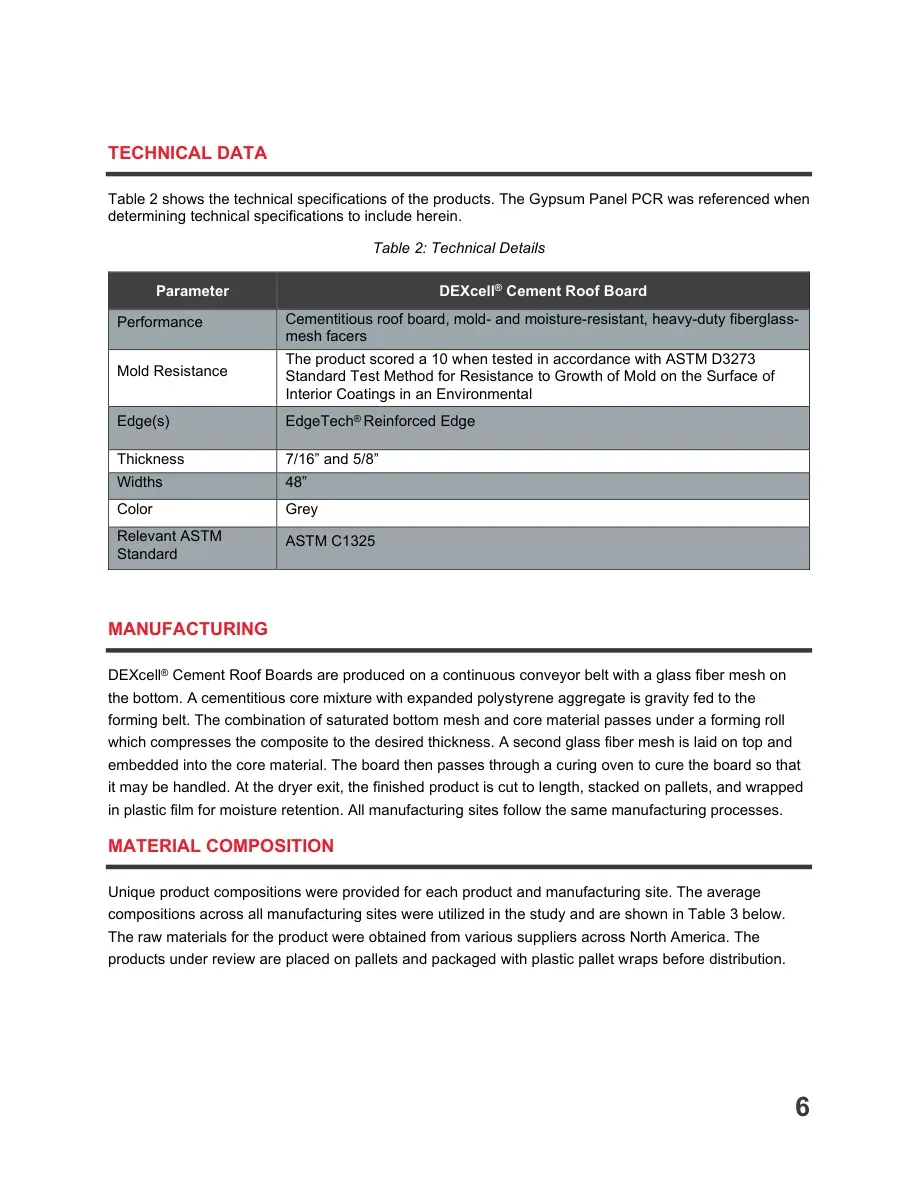
6 TECHNICAL DATA Table 2 shows the technical specifications of the products. The Gypsum Panel PCR was referenced when determining technical specifications to include herein. Table 2: Technical Details Parameter DEXcell® Cement Roof Board Performance Cementitious roof board, mold- and moisture-resistant, heavy-duty fiberglass-mesh facers Mold Resistance The product scored a 10 when tested in accordance with ASTM D3273 Standard Test Method for Resistance to Growth of Mold on the Surface of Interior Coatings in an Environmental Edge(s) EdgeTech® Reinforced Edge Thickness 7/16” and 5/8” Widths 48” Color Grey Relevant ASTM Standard ASTM C1325 MANUFACTURING DEXcell® Cement Roof Boards are produced on a continuous conveyor belt with a glass fiber mesh on the bottom. A cementitious core mixture with expanded polystyrene aggregate is gravity fed to the forming belt. The combination of saturated bottom mesh and core material passes under a forming roll which compresses the composite to the desired thickness. A second glass fiber mesh is laid on top and embedded into the core material. The board then passes through a curing oven to cure the board so that it may be handled. At the dryer exit, the finished product is cut to length, stacked on pallets, and wrapped in plastic film for moisture retention. All manufacturing sites follow the same manufacturing processes. MATERIAL COMPOSITION Unique product compositions were provided for each product and manufacturing site. The average compositions across all manufacturing sites were utilized in the study and are shown in Table 3 below. The raw materials for the product were obtained from various suppliers across North America. The products under review are placed on pallets and packaged with plastic pallet wraps before distribution.
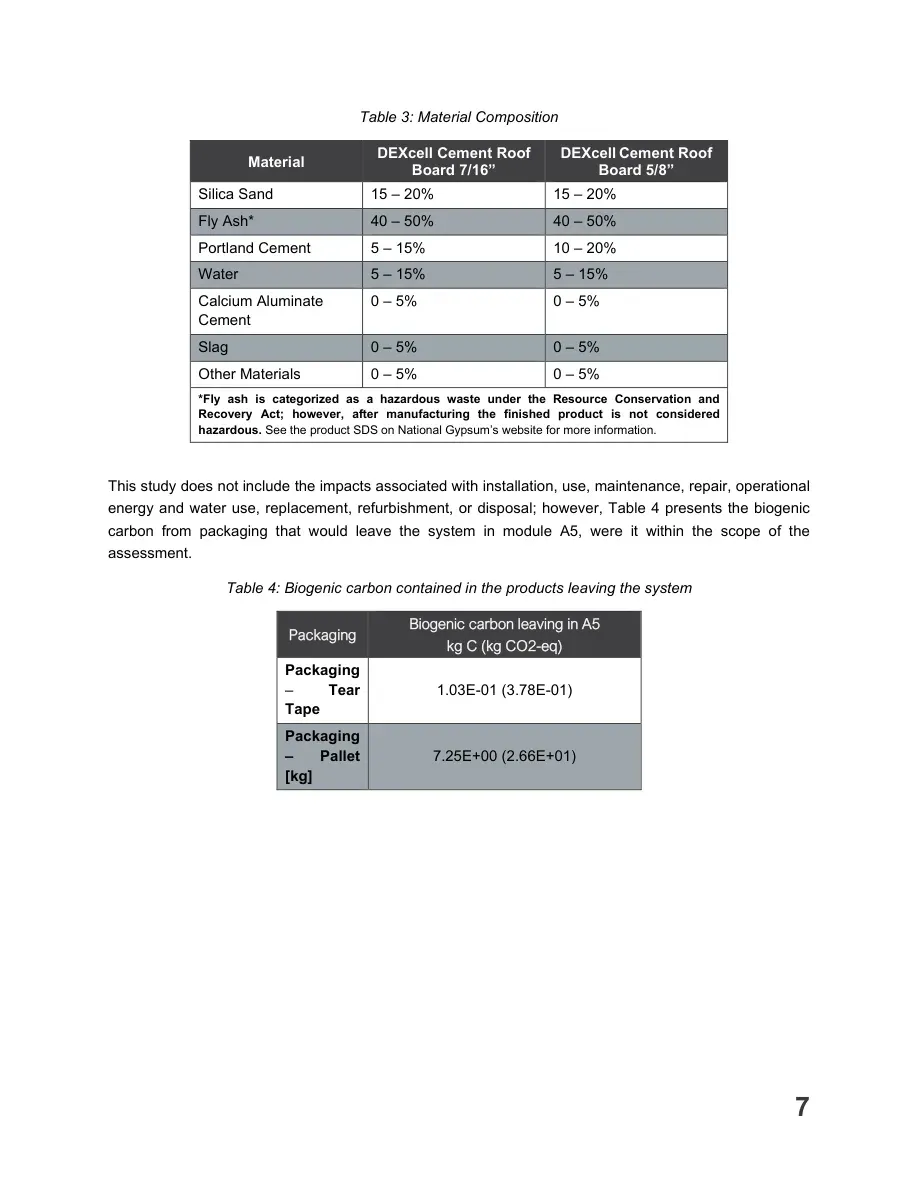
7 Table 3: Material Composition Material DEXcell Cement Roof Board 7/16” DEXcell Cement Roof Board 5/8” Silica Sand 15 – 20% 15 – 20% Fly Ash* 40 – 50% 40 – 50% Portland Cement 5 – 15% 10 – 20% Water 5 – 15% 5 – 15% Calcium Aluminate Cement 0 – 5% 0 – 5% Slag 0 – 5% 0 – 5% Other Materials 0 – 5% 0 – 5% *Fly ash is categorized as a hazardous waste under the Resource Conservation and Recovery Act; however, after manufacturing the finished product is not considered hazardous. See the product SDS on National Gypsum’s website for more information. This study does not include the impacts associated with installation, use, maintenance, repair, operational energy and water use, replacement, refurbishment, or disposal; however, Table 4 presents the biogenic carbon from packaging that would leave the system in module A5, were it within the scope of the assessment. Table 4: Biogenic carbon contained in the products leaving the system Packaging Biogenic carbon leaving in A5 kg C (kg CO2-eq) Packaging – Tear Tape 1.03E-01 (3.78E-01) Packaging – Pallet [kg] 7.25E+00 (2.66E+01)
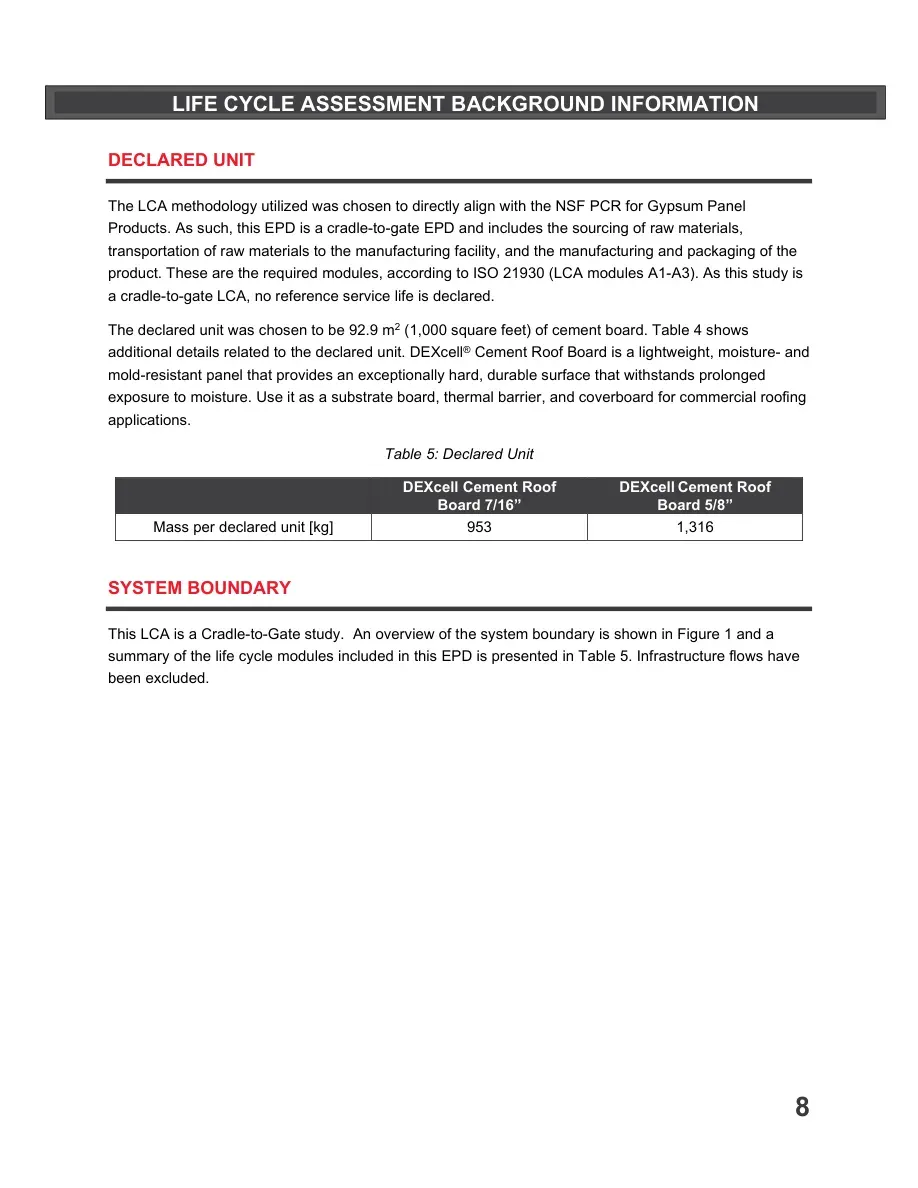
8 DECLARED UNIT The LCA methodology utilized was chosen to directly align with the NSF PCR for Gypsum Panel Products. As such, this EPD is a cradle-to-gate EPD and includes the sourcing of raw materials, transportation of raw materials to the manufacturing facility, and the manufacturing and packaging of the product. These are the required modules, according to ISO 21930 (LCA modules A1-A3). As this study is a cradle-to-gate LCA, no reference service life is declared. The declared unit was chosen to be 92.9 m2 (1,000 square feet) of cement board. Table 4 shows additional details related to the declared unit. DEXcell® Cement Roof Board is a lightweight, moisture- and mold-resistant panel that provides an exceptionally hard, durable surface that withstands prolonged exposure to moisture. Use it as a substrate board, thermal barrier, and coverboard for commercial roofing applications. Table 5: Declared Unit DEXcell Cement Roof Board 7/16” DEXcell Cement Roof Board 5/8” Mass per declared unit [kg] 953 1,316 SYSTEM BOUNDARY This LCA is a Cradle-to-Gate study. An overview of the system boundary is shown in Figure 1 and a summary of the life cycle modules included in this EPD is presented in Table 5. Infrastructure flows have been excluded. LIFE CYCLE ASSESSMENT BACKGROUND INFORMATION
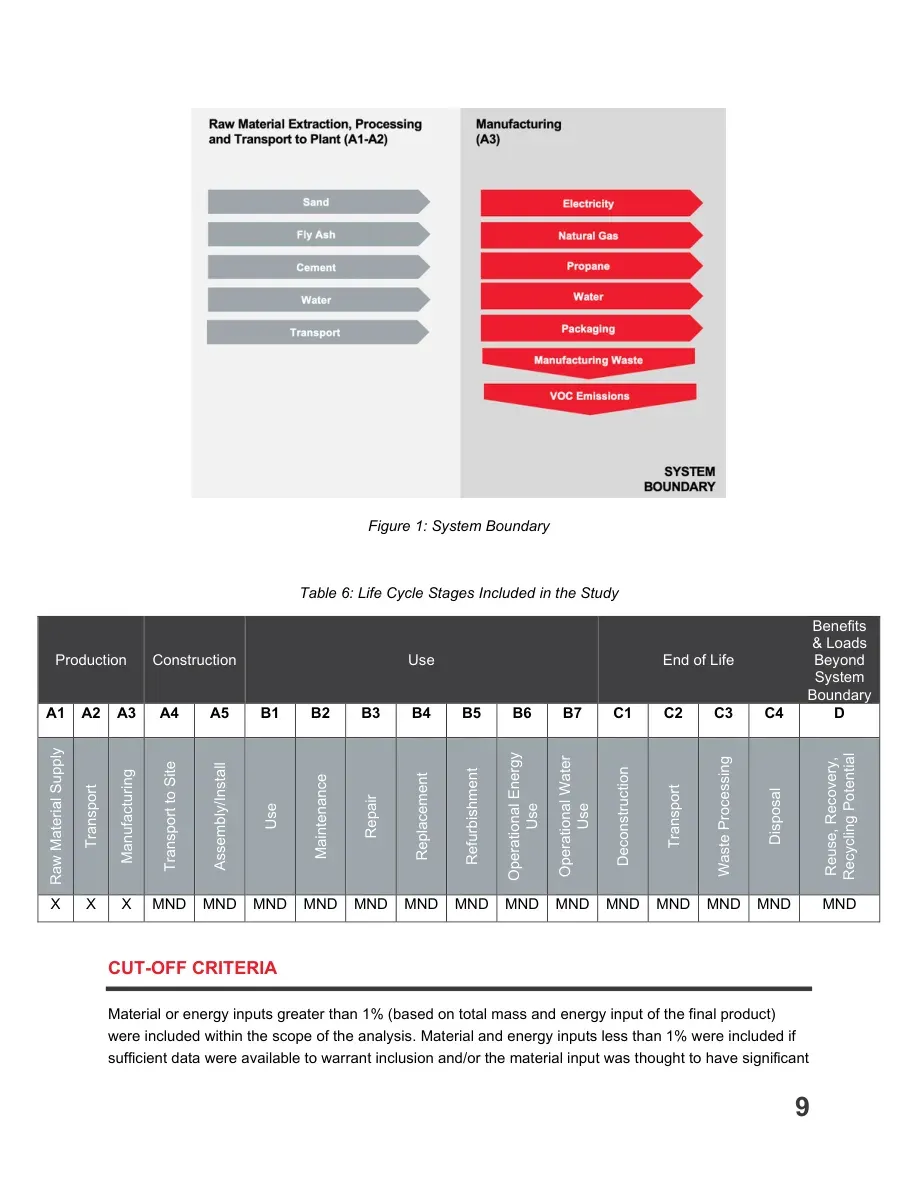
9 Figure 1: System Boundary Table 6: Life Cycle Stages Included in the Study Production Construction Use End of Life Benefits & Loads Beyond System Boundary A1 A2 A3 A4 A5 B1 B2 B3 B4 B5 B6 B7 C1 C2 C3 C4 D Raw Material Supply Transport Manufacturing Transport to Site Assembly/Install Use Maintenance Repair Replacement Refurbishment Operational Energy Use Operational Water Use Deconstruction Transport Waste Processing Disposal Reuse, Recovery, Recycling Potential X X X MND MND MND MND MND MND MND MND MND MND MND MND MND MND CUT-OFF CRITERIA Material or energy inputs greater than 1% (based on total mass and energy input of the final product) were included within the scope of the analysis. Material and energy inputs less than 1% were included if sufficient data were available to warrant inclusion and/or the material input was thought to have significant
10environmental impact. Cumulative excluded material and energy inputs and environmental impacts are less than 5% based on total weight of the declared unit. No known flows were deliberately excluded from this EPD. ALLOCATION General principles of allocation were based on ISO 14040/44. To derive a per-unit value for the manufacturing inputs/outputs, mass allocation based on total production at each manufacturing facility was adopted. For all plants that make the reviewed products, the total consumption during 2022 was divided by the total production mass during 2022 to derive a weighted-average use-per-production unit value. PermaBASE® Building Products’ associates determined the best way to allocate inputs. This allocation methodology was used for the following inputs: • Electricity • Thermal Energy from Natural Gas • Propane • Water • Waste Discussions with PermaBASE® Building Products’ staff revealed this was a representative way to allocate the manufacturing inputs/outputs due to the fact that all products created at the facilities are similar in nature. As a default, secondary GaBi datasets use a physical mass basis for allocation.
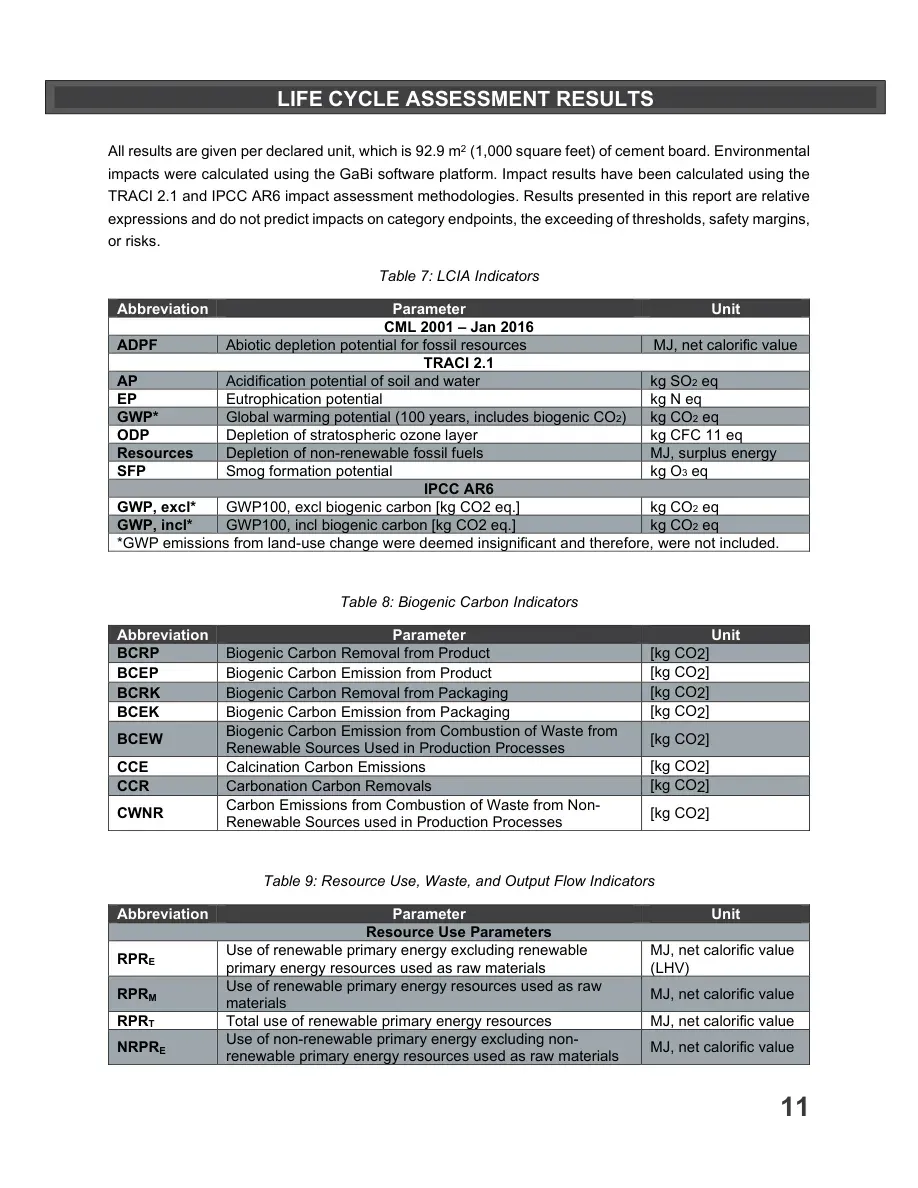
11 All results are given per declared unit, which is 92.9 m2 (1,000 square feet) of cement board. Environmental impacts were calculated using the GaBi software platform. Impact results have been calculated using the TRACI 2.1 and IPCC AR6 impact assessment methodologies. Results presented in this report are relative expressions and do not predict impacts on category endpoints, the exceeding of thresholds, safety margins, or risks. Table 7: LCIA Indicators Abbreviation Parameter Unit CML 2001 – Jan 2016 ADPF Abiotic depletion potential for fossil resources MJ, net calorific value TRACI 2.1 AP Acidification potential of soil and water kg SO2 eq EP Eutrophication potential kg N eq GWP* Global warming potential (100 years, includes biogenic CO2) kg CO2 eq ODP Depletion of stratospheric ozone layer kg CFC 11 eq Resources Depletion of non-renewable fossil fuels MJ, surplus energy SFP Smog formation potential kg O3 eq IPCC AR6 GWP, excl* GWP100, excl biogenic carbon [kg CO2 eq.] kg CO2 eq GWP, incl* GWP100, incl biogenic carbon [kg CO2 eq.] kg CO2 eq *GWP emissions from land-use change were deemed insignificant and therefore, were not included. Table 8: Biogenic Carbon Indicators Abbreviation Parameter Unit BCRP Biogenic Carbon Removal from Product [kg CO2] BCEP Biogenic Carbon Emission from Product [kg CO2] BCRK Biogenic Carbon Removal from Packaging [kg CO2] BCEK Biogenic Carbon Emission from Packaging [kg CO2] BCEW Biogenic Carbon Emission from Combustion of Waste from Renewable Sources Used in Production Processes [kg CO2] CCE Calcination Carbon Emissions [kg CO2] CCR Carbonation Carbon Removals [kg CO2] CWNR Carbon Emissions from Combustion of Waste from Non- Renewable Sources used in Production Processes [kg CO2] Table 9: Resource Use, Waste, and Output Flow Indicators Abbreviation Parameter Unit Resource Use Parameters RPRE Use of renewable primary energy excluding renewable primary energy resources used as raw materials MJ, net calorific value (LHV) RPRM Use of renewable primary energy resources used as raw materials MJ, net calorific value RPRT Total use of renewable primary energy resources MJ, net calorific value NRPRE Use of non-renewable primary energy excluding non-renewable primary energy resources used as raw materials MJ, net calorific value LIFE CYCLE ASSESSMENT RESULTS
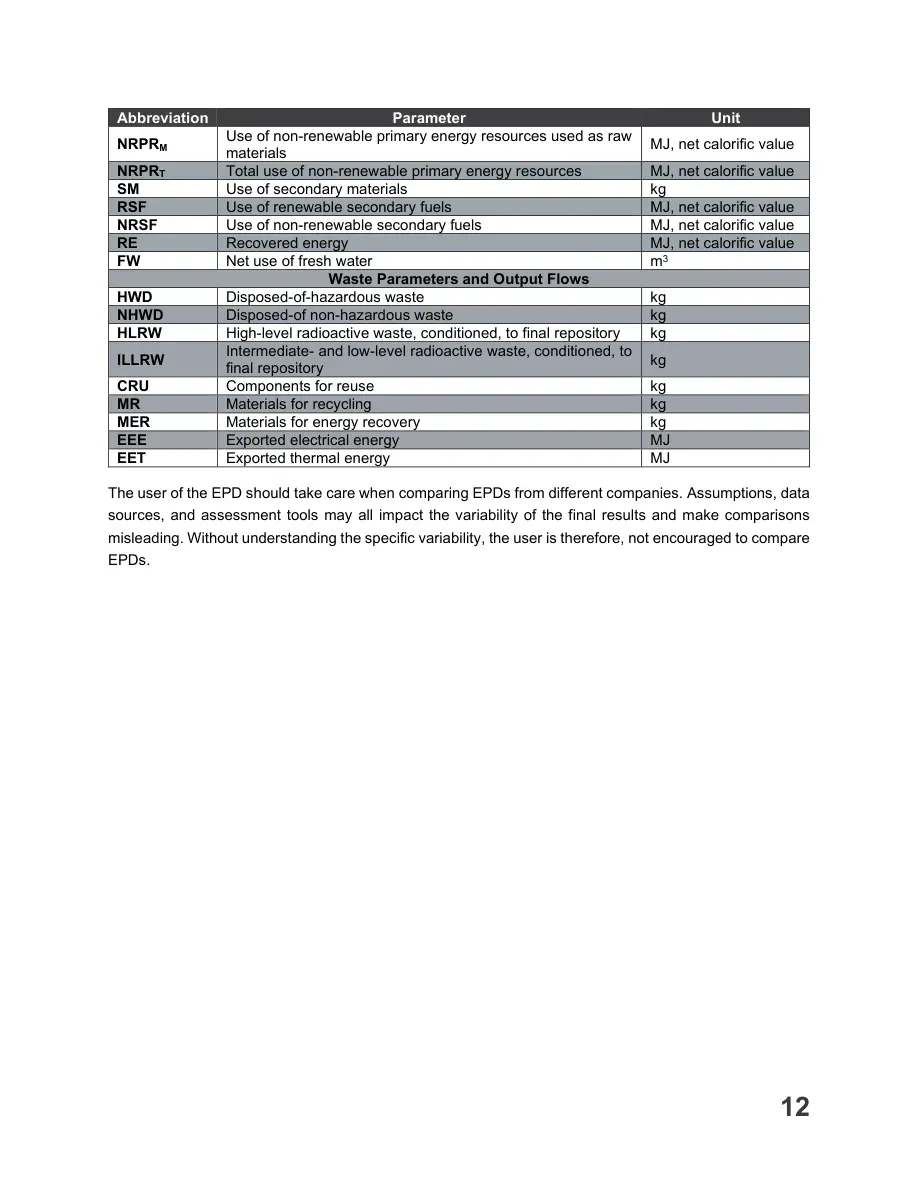
12Abbreviation Parameter Unit NRPRM Use of non-renewable primary energy resources used as raw materials MJ, net calorific value NRPRT Total use of non-renewable primary energy resources MJ, net calorific value SM Use of secondary materials kg RSF Use of renewable secondary fuels MJ, net calorific value NRSF Use of non-renewable secondary fuels MJ, net calorific value RE Recovered energy MJ, net calorific value FW Net use of fresh water m3 Waste Parameters and Output Flows HWD Disposed-of-hazardous waste kg NHWD Disposed-of non-hazardous waste kg HLRW High-level radioactive waste, conditioned, to final repository kg ILLRW Intermediate- and low-level radioactive waste, conditioned, to final repository kg CRU Components for reuse kg MR Materials for recycling kg MER Materials for energy recovery kg EEE Exported electrical energy MJ EET Exported thermal energy MJ The user of the EPD should take care when comparing EPDs from different companies. Assumptions, data sources, and assessment tools may all impact the variability of the final results and make comparisons misleading. Without understanding the specific variability, the user is therefore, not encouraged to compare EPDs.
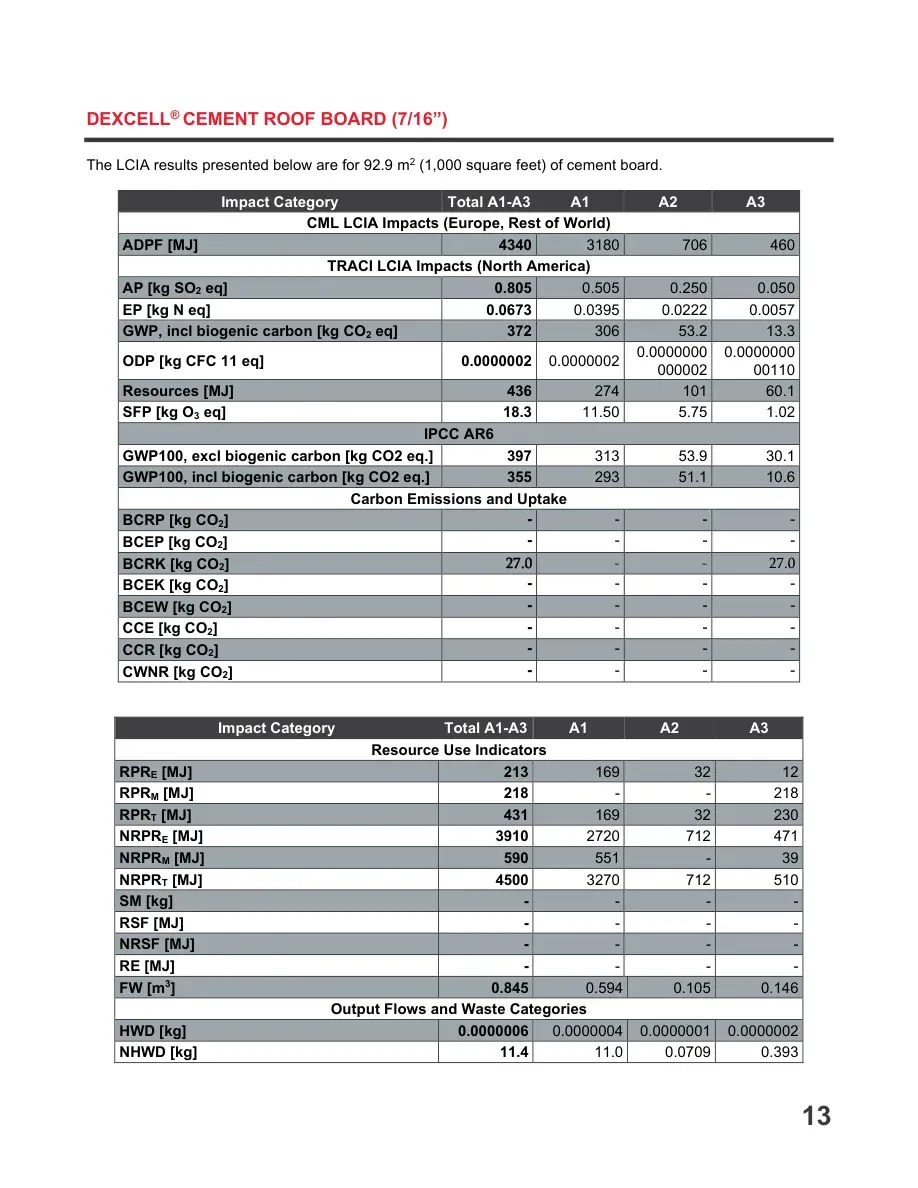
13DEXCELL® CEMENT ROOF BOARD (7/16”) The LCIA results presented below are for 92.9 m2 (1,000 square feet) of cement board. Impact Category Total A1-A3 A1 A2 A3 CML LCIA Impacts (Europe, Rest of World) ADPF [MJ] 4340 3180 706 460 TRACI LCIA Impacts (North America) AP [kg SO2 eq] 0.805 0.505 0.250 0.050 EP [kg N eq] 0.0673 0.0395 0.0222 0.0057 GWP, incl biogenic carbon [kg CO2 eq] 372 306 53.2 13.3 ODP [kg CFC 11 eq] 0.0000002 0.0000002 0.0000000000002 0.000000000110 Resources [MJ] 436 274 101 60.1 SFP [kg O3 eq] 18.3 11.50 5.75 1.02 IPCC AR6 GWP100, excl biogenic carbon [kg CO2 eq.] 397 313 53.9 30.1 GWP100, incl biogenic carbon [kg CO2 eq.] 355 293 51.1 10.6 Carbon Emissions and Uptake BCRP [kg CO2] - - - - BCEP [kg CO2] - - - - BCRK [kg CO2] 27.0 - - 27.0 BCEK [kg CO2] - - - - BCEW [kg CO2] - - - - CCE [kg CO2] - - - - CCR [kg CO2] - - - - CWNR [kg CO2] - - - - Impact Category Total A1-A3 A1 A2 A3 Resource Use Indicators RPRE [MJ] 213 169 32 12 RPRM [MJ] 218 - - 218 RPRT [MJ] 431 169 32 230 NRPRE [MJ] 3910 2720 712 471 NRPRM [MJ] 590 551 - 39 NRPRT [MJ] 4500 3270 712 510 SM [kg] - - - - RSF [MJ] - - - - NRSF [MJ] - - - - RE [MJ] - - - - FW [m3] 0.845 0.594 0.105 0.146 Output Flows and Waste Categories HWD [kg] 0.0000006 0.0000004 0.0000001 0.0000002 NHWD [kg] 11.4 11.0 0.0709 0.393
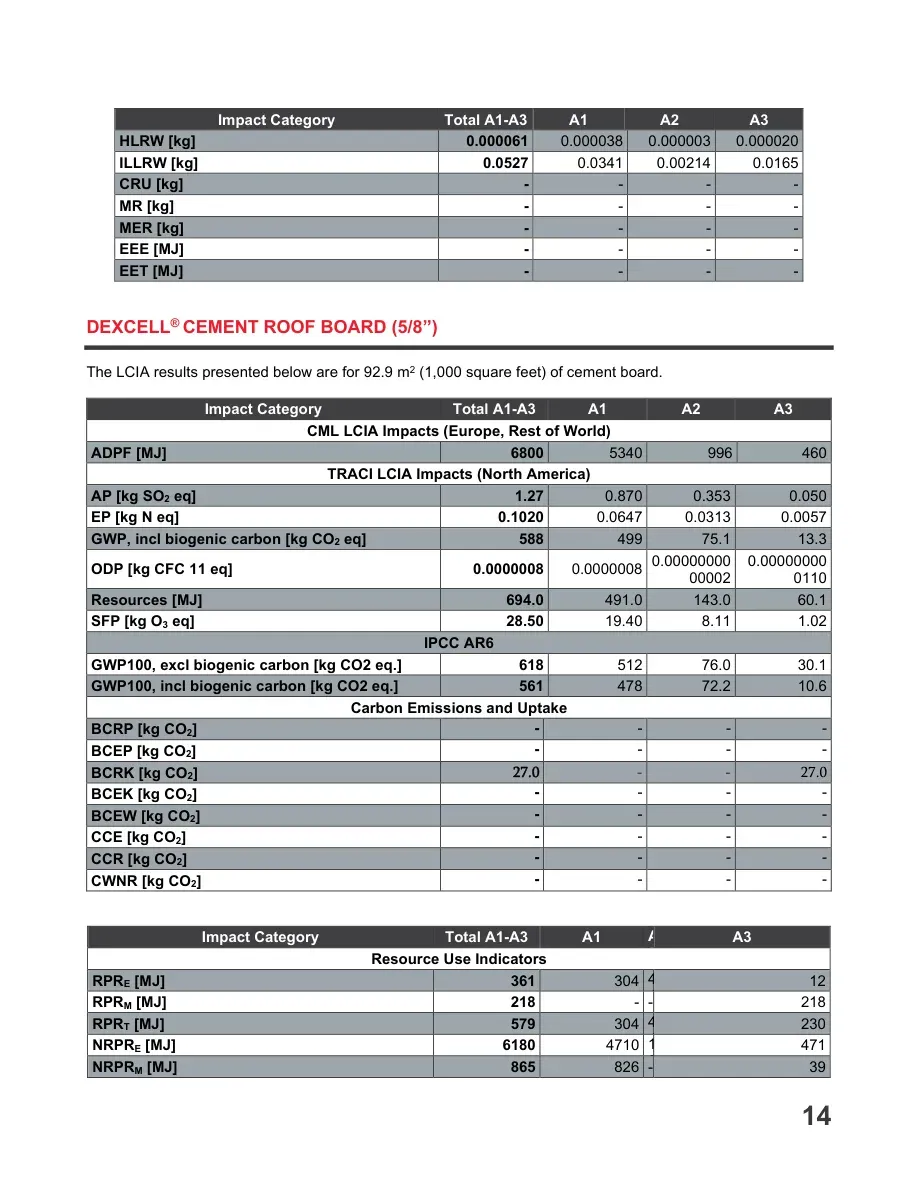
14Impact Category Total A1-A3 A1 A2 A3 HLRW [kg] 0.000061 0.000038 0.000003 0.000020 ILLRW [kg] 0.0527 0.0341 0.00214 0.0165 CRU [kg] - - - - MR [kg] - - - - MER [kg] - - - - EEE [MJ] - - - - EET [MJ] - - - - DEXCELL® CEMENT ROOF BOARD (5/8”) The LCIA results presented below are for 92.9 m2 (1,000 square feet) of cement board. Impact Category Total A1-A3 A1 A2 A3 CML LCIA Impacts (Europe, Rest of World) ADPF [MJ] 6800 5340 996 460 TRACI LCIA Impacts (North America) AP [kg SO2 eq] 1.27 0.870 0.353 0.050 EP [kg N eq] 0.1020 0.0647 0.0313 0.0057 GWP, incl biogenic carbon [kg CO2 eq] 588 499 75.1 13.3 ODP [kg CFC 11 eq] 0.0000008 0.0000008 0.0000000000002 0.000000000110 Resources [MJ] 694.0 491.0 143.0 60.1 SFP [kg O3 eq] 28.50 19.40 8.11 1.02 IPCC AR6 GWP100, excl biogenic carbon [kg CO2 eq.] 618 512 76.0 30.1 GWP100, incl biogenic carbon [kg CO2 eq.] 561 478 72.2 10.6 Carbon Emissions and Uptake BCRP [kg CO2] - - - - BCEP [kg CO2] - - - - BCRK [kg CO2] 27.0 - - 27.0 BCEK [kg CO2] - - - - BCEW [kg CO2] - - - - CCE [kg CO2] - - - - CCR [kg CO2] - - - - CWNR [kg CO2] - - - - Impact Category Total A1-A3 A1 A2A3 Resource Use Indicators RPRE [MJ] 361 304 4412 RPRM [MJ] 218 - - 218 RPRT [MJ] 579 304 44230 NRPRE [MJ] 6180 4710 10471 NRPRM [MJ] 865 826 - 39
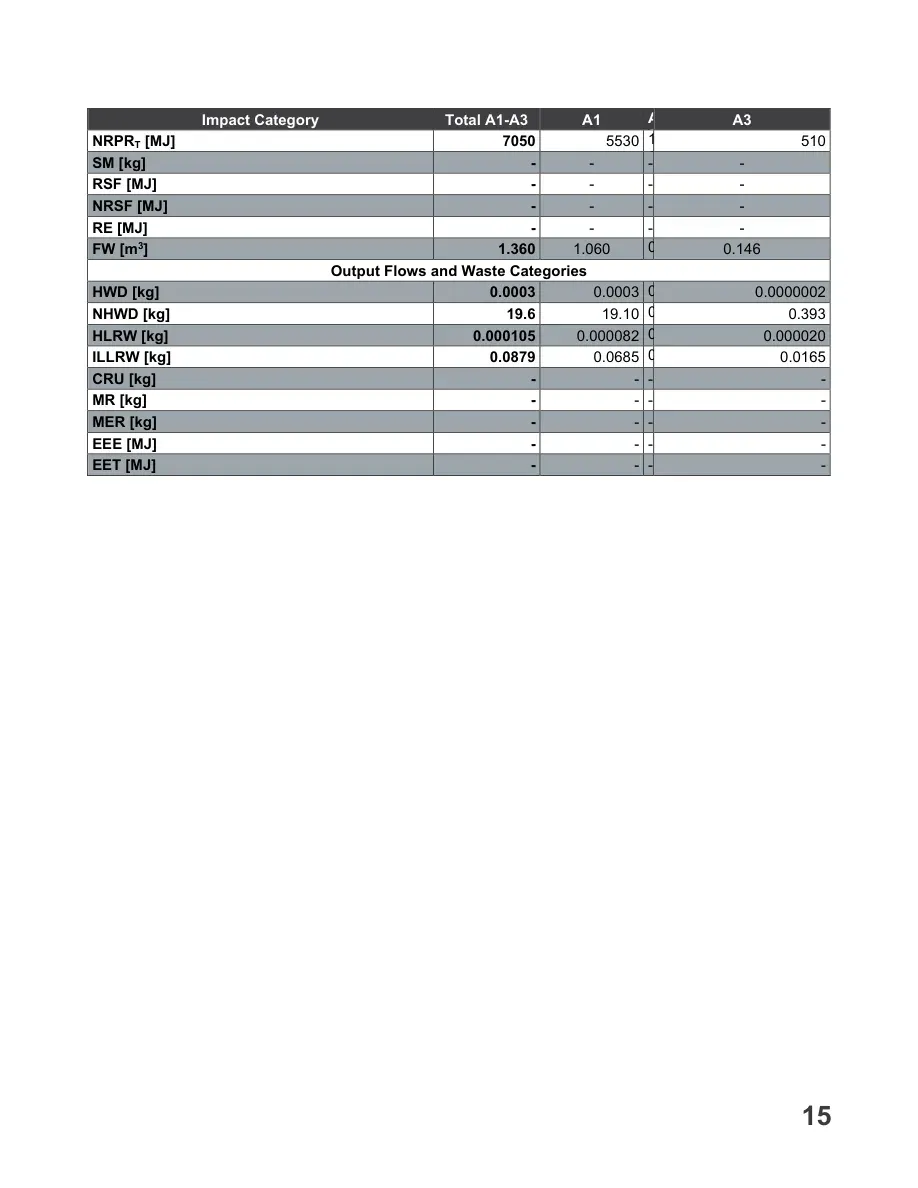
15Impact Category Total A1-A3 A1 A2A3 NRPRT [MJ] 7050 5530 10510 SM [kg] - - - - RSF [MJ] - - - - NRSF [MJ] - - - - RE [MJ] - - - - FW [m3] 1.360 1.060 00.146 Output Flows and Waste Categories HWD [kg] 0.0003 0.0003 00.0000002 NHWD [kg] 19.6 19.10 00.393 HLRW [kg] 0.000105 0.000082 00.000020 ILLRW [kg] 0.0879 0.0685 00.0165 CRU [kg] - - - - MR [kg] - - - - MER [kg] - - - - EEE [MJ] - - - - EET [MJ] - - - -
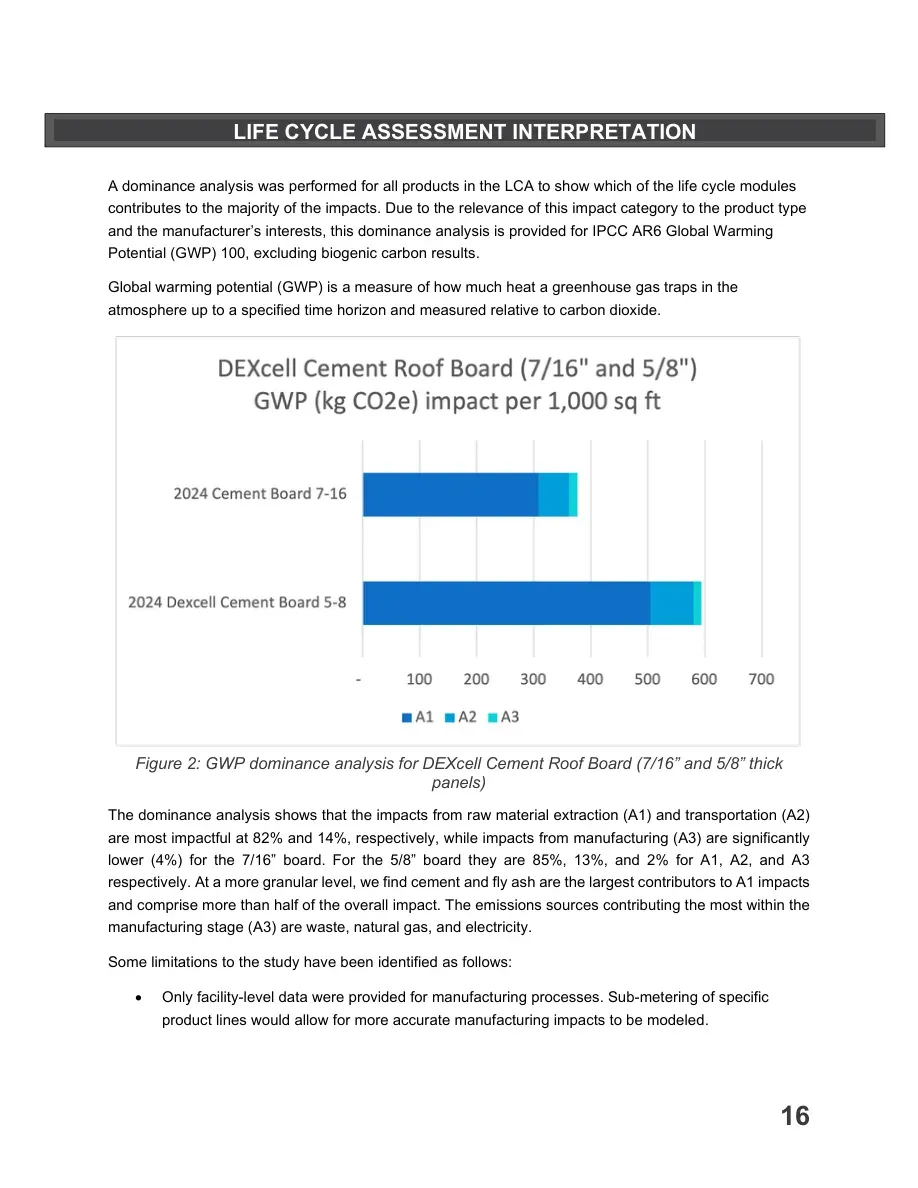
16 A dominance analysis was performed for all products in the LCA to show which of the life cycle modules contributes to the majority of the impacts. Due to the relevance of this impact category to the product type and the manufacturer’s interests, this dominance analysis is provided for IPCC AR6 Global Warming Potential (GWP) 100, excluding biogenic carbon results. Global warming potential (GWP) is a measure of how much heat a greenhouse gas traps in the atmosphere up to a specified time horizon and measured relative to carbon dioxide. Figure 2: GWP dominance analysis for DEXcell Cement Roof Board (7/16” and 5/8” thick panels) The dominance analysis shows that the impacts from raw material extraction (A1) and transportation (A2) are most impactful at 82% and 14%, respectively, while impacts from manufacturing (A3) are significantly lower (4%) for the 7/16” board. For the 5/8” board they are 85%, 13%, and 2% for A1, A2, and A3 respectively. At a more granular level, we find cement and fly ash are the largest contributors to A1 impacts and comprise more than half of the overall impact. The emissions sources contributing the most within the manufacturing stage (A3) are waste, natural gas, and electricity. Some limitations to the study have been identified as follows: • Only facility-level data were provided for manufacturing processes. Sub-metering of specific product lines would allow for more accurate manufacturing impacts to be modeled. LIFE CYCLE ASSESSMENT INTERPRETATION
17• The study represents an average of four manufacturing sites; therefore, site-specific results may differ. • Availability of geographically more accurate datasets would have improved the accuracy of the study. • Only known and quantifiable environmental impacts are considered. • Due to the assumptions and value choices listed above, these do not reflect real-life scenarios and hence they cannot assess actual and exact impacts, but only potential environmental impacts. ENVIRONMENTAL ACTIVITIES AND CERTIFICATIONS DEXcell® Cement Roof Board products are UL GREENGUARD Gold certified. Additionally, a Health Product Declaration (“HPD”) is published for DEXcell® Cement Roof Board (7/16” and 5/8”). ADDITIONAL ENVIRONMENTAL INFORMATION
18 1. CML - Department of Industrial Ecology. (2016, September 05). CML-IA Characterisation Factors. Retrieved from https://www.universiteitleiden.nl/en/research/research-output/science/cml-ia-characterisation-factors 2. IPCC. (2013). Climate Change 2013: The Physical Science Basis. Contributin of Working Group I to the Fifth Assessment Report of the Intergovernmental Panel on Climate Change. [Stocker, T.F., D. Qin, G.-K. Plattner, M. Tignor, S.K. Allen, J. Boschung, A. Nauels, Y. Xia, V. Bex and P.M. Midgley (eds.)]. Cambrige, United Kingdom and New York, NY, USA: Cambridge University press. 3. ISO. (2006). ISO 14025: Environmental labels and declarations - Type III environmental declarations - Principles and procedures. Geneva: International Organization for Standardization. 4. ISO. (2006). ISO 14040/Amd 1:2020: Environmental management - Life cycle assessment - Principles and framework. Geneva: International Organization for Standardization. 5. ISO. (2017). ISO 14044/Amd 1:2017/Amd 2:2020: Environemntal Managment - Life cycle assessment - Requirements and Guidelines. Geneva: International Organization for Standardization. 6. ISO. (2017). ISO 21930: Sustainability in buildings and civil engineering works - Core rules for environmental product declarations of construction products and services. Geneva: International Organization for Standardization. 7. NSF International. (April 2020). Product Category Rule Environmental Product Declarations, PCR for Gypsum Panel Products. 8. US EPA. (2012). TRACI: The Tool for the Reduction and Assessment of Chemical and Other Environmental Impacts. Version 2.1 - User Guide. Retrieved from https://nepis.epa.gov/Adobe/PDF/P100HN53.pdf REFERENCES