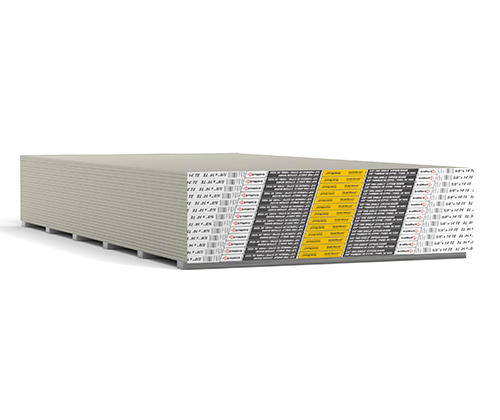
1 ENVIRONMENTAL PRODUCT DECLARATION GOLD BOND® FIRE-SHIELD® GYPSUM BOARD (5/8”) SHIPPINGPORT, PA PLANT ACCORDING TO ISO 14025 AND ISO 21930 Type III environmental product declaration (EPD) developed according to ISO 14025 and 21930 for Gold Bond® Fire-Shield® Gypsum Board (5/8”) National Gypsum Company is the exclusive service provider for products manufactured by Gold Bond Building Products, LLC.
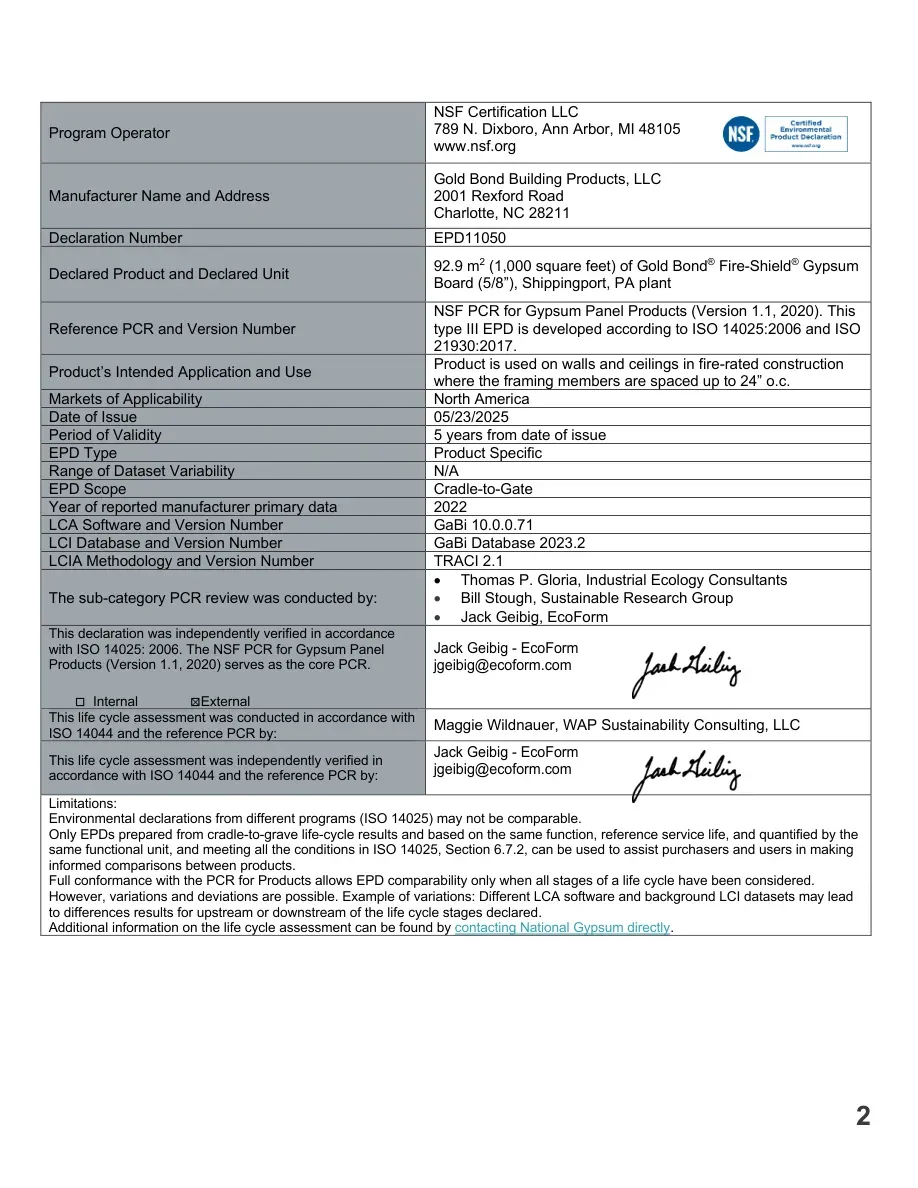
2 Program Operator NSF Certification LLC 789 N. Dixboro, Ann Arbor, MI 48105 www.nsf.org Manufacturer Name and Address Gold Bond Building Products, LLC 2001 Rexford Road Charlotte, NC 28211 Declaration Number EPD11050 Declared Product and Declared Unit 92.9 m2 (1,000 square feet) of Gold Bond® Fire-Shield® Gypsum Board (5/8”), Shippingport, PA plant Reference PCR and Version Number NSF PCR for Gypsum Panel Products (Version 1.1, 2020). This type III EPD is developed according to ISO 14025:2006 and ISO 21930:2017. Product’s Intended Application and Use Product is used on walls and ceilings in fire-rated construction where the framing members are spaced up to 24” o.c. Markets of Applicability North America Date of Issue 05/23/2025 Period of Validity 5 years from date of issue EPD Type Product Specific Range of Dataset Variability N/A EPD Scope Cradle-to-Gate Year of reported manufacturer primary data 2022 LCA Software and Version Number GaBi 10.0.0.71 LCI Database and Version Number GaBi Database 2023.2 LCIA Methodology and Version Number TRACI 2.1 The sub-category PCR review was conducted by: • Thomas P. Gloria, Industrial Ecology Consultants • Bill Stough, Sustainable Research Group • Jack Geibig, EcoForm This declaration was independently verified in accordance with ISO 14025: 2006. The NSF PCR for Gypsum Panel Products (Version 1.1, 2020) serves as the core PCR. Internal External Jack Geibig - EcoForm jgeibig@ecoform.com This life cycle assessment was conducted in accordance with ISO 14044 and the reference PCR by: Maggie Wildnauer, WAP Sustainability Consulting, LLC This life cycle assessment was independently verified in accordance with ISO 14044 and the reference PCR by: Jack Geibig - EcoForm jgeibig@ecoform.com Limitations: Environmental declarations from different programs (ISO 14025) may not be comparable. Only EPDs prepared from cradle-to-grave life-cycle results and based on the same function, reference service life, and quantified by the same functional unit, and meeting all the conditions in ISO 14025, Section 6.7.2, can be used to assist purchasers and users in making informed comparisons between products. Full conformance with the PCR for Products allows EPD comparability only when all stages of a life cycle have been considered. However, variations and deviations are possible. Example of variations: Different LCA software and background LCI datasets may lead to differences results for upstream or downstream of the life cycle stages declared. Additional information on the life cycle assessment can be found by contacting National Gypsum directly.
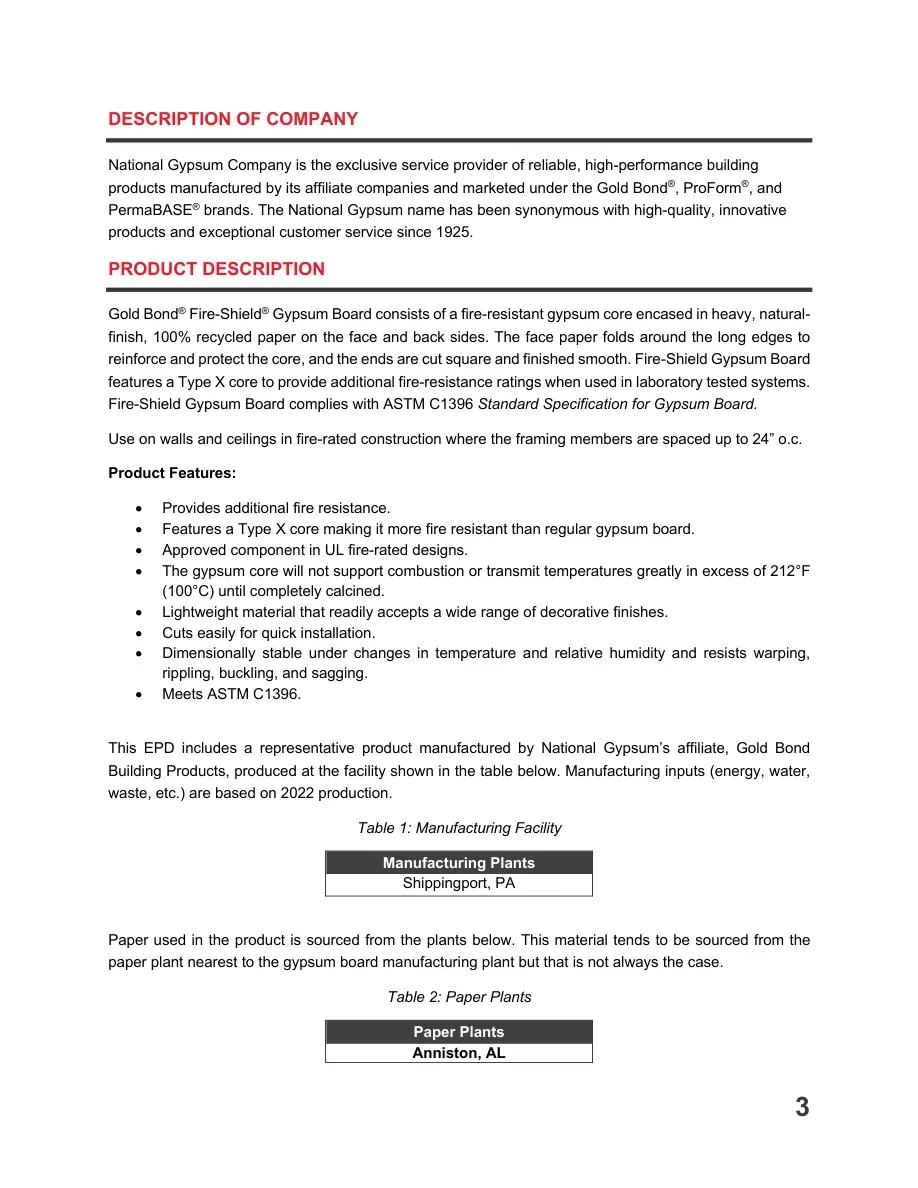
3 DESCRIPTION OF COMPANY National Gypsum Company is the exclusive service provider of reliable, high-performance building products manufactured by its affiliate companies and marketed under the Gold Bond®, ProForm®, and PermaBASE® brands. The National Gypsum name has been synonymous with high-quality, innovative products and exceptional customer service since 1925. PRODUCT DESCRIPTION Gold Bond® Fire-Shield® Gypsum Board consists of a fire-resistant gypsum core encased in heavy, natural-finish, 100% recycled paper on the face and back sides. The face paper folds around the long edges to reinforce and protect the core, and the ends are cut square and finished smooth. Fire-Shield Gypsum Board features a Type X core to provide additional fire-resistance ratings when used in laboratory tested systems. Fire-Shield Gypsum Board complies with ASTM C1396 Standard Specification for Gypsum Board. Use on walls and ceilings in fire-rated construction where the framing members are spaced up to 24” o.c. Product Features: • Provides additional fire resistance. • Features a Type X core making it more fire resistant than regular gypsum board. • Approved component in UL fire-rated designs. • The gypsum core will not support combustion or transmit temperatures greatly in excess of 212°F (100°C) until completely calcined. • Lightweight material that readily accepts a wide range of decorative finishes. • Cuts easily for quick installation. • Dimensionally stable under changes in temperature and relative humidity and resists warping, rippling, buckling, and sagging. • Meets ASTM C1396. This EPD includes a representative product manufactured by National Gypsum’s affiliate, Gold Bond Building Products, produced at the facility shown in the table below. Manufacturing inputs (energy, water, waste, etc.) are based on 2022 production. Table 1: Manufacturing Facility Manufacturing Plants Shippingport, PA Paper used in the product is sourced from the plants below. This material tends to be sourced from the paper plant nearest to the gypsum board manufacturing plant but that is not always the case. Table 2: Paper Plants Paper Plants Anniston, AL
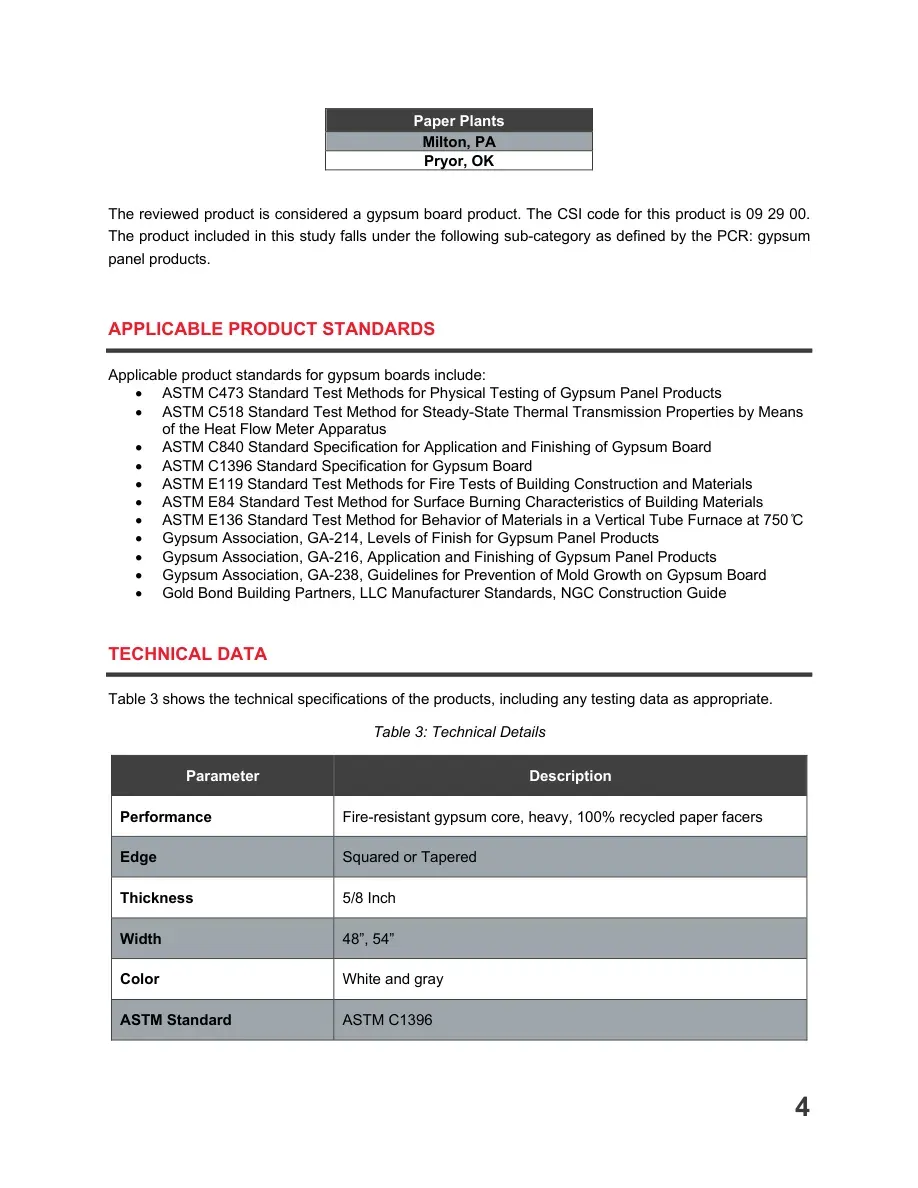
4 Paper Plants Milton, PA Pryor, OK The reviewed product is considered a gypsum board product. The CSI code for this product is 09 29 00. The product included in this study falls under the following sub-category as defined by the PCR: gypsum panel products. APPLICABLE PRODUCT STANDARDS Applicable product standards for gypsum boards include: • ASTM C473 Standard Test Methods for Physical Testing of Gypsum Panel Products • ASTM C518 Standard Test Method for Steady-State Thermal Transmission Properties by Means of the Heat Flow Meter Apparatus • ASTM C840 Standard Specification for Application and Finishing of Gypsum Board • ASTM C1396 Standard Specification for Gypsum Board • ASTM E119 Standard Test Methods for Fire Tests of Building Construction and Materials • ASTM E84 Standard Test Method for Surface Burning Characteristics of Building Materials • ASTM E136 Standard Test Method for Behavior of Materials in a Vertical Tube Furnace at 750 ̊C • Gypsum Association, GA-214, Levels of Finish for Gypsum Panel Products • Gypsum Association, GA-216, Application and Finishing of Gypsum Panel Products • Gypsum Association, GA-238, Guidelines for Prevention of Mold Growth on Gypsum Board • Gold Bond Building Partners, LLC Manufacturer Standards, NGC Construction Guide TECHNICAL DATA Table 3 shows the technical specifications of the products, including any testing data as appropriate. Table 3: Technical Details Parameter Description Performance Fire-resistant gypsum core, heavy, 100% recycled paper facers Edge Squared or Tapered Thickness 5/8 Inch Width 48”, 54” Color White and gray ASTM Standard ASTM C1396
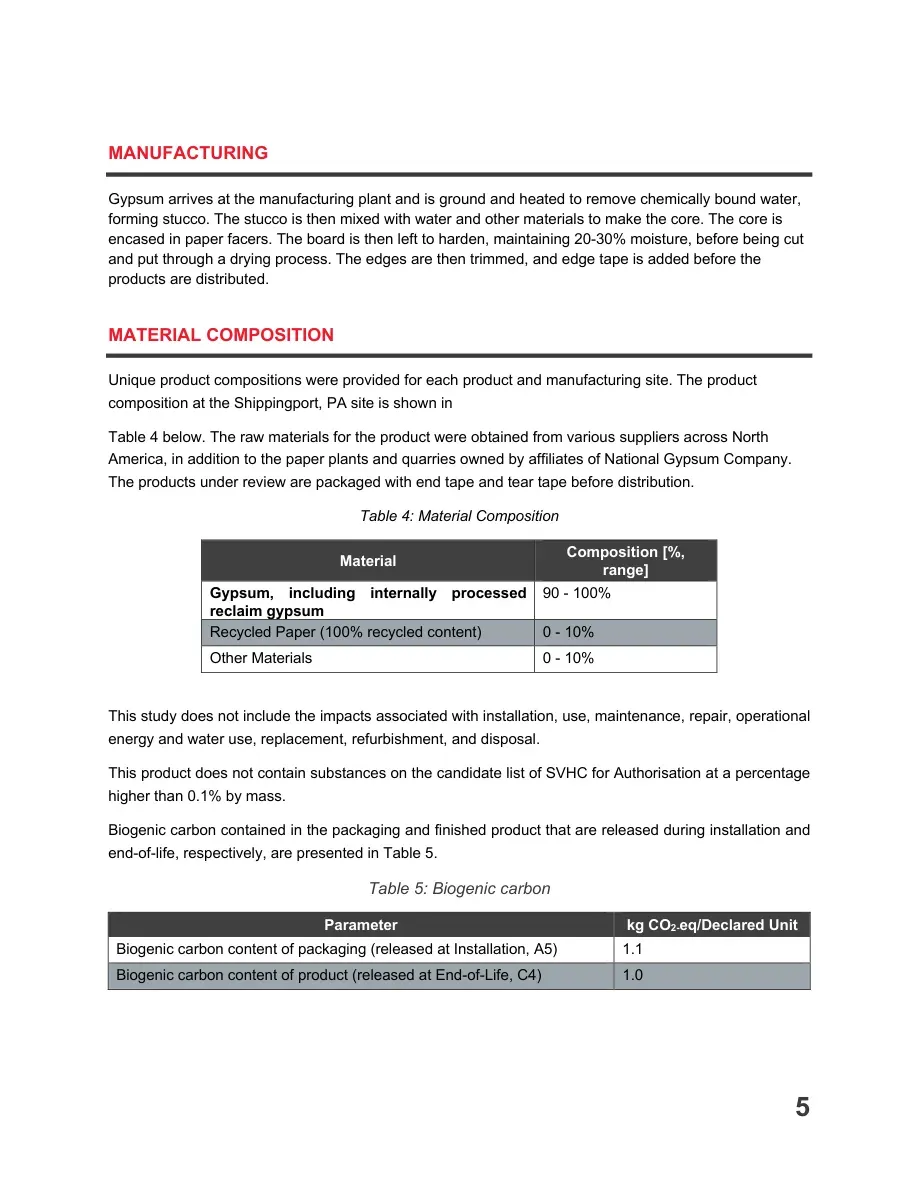
5 MANUFACTURING Gypsum arrives at the manufacturing plant and is ground and heated to remove chemically bound water, forming stucco. The stucco is then mixed with water and other materials to make the core. The core is encased in paper facers. The board is then left to harden, maintaining 20-30% moisture, before being cut and put through a drying process. The edges are then trimmed, and edge tape is added before the products are distributed. MATERIAL COMPOSITION Unique product compositions were provided for each product and manufacturing site. The product composition at the Shippingport, PA site is shown in Table 4 below. The raw materials for the product were obtained from various suppliers across North America, in addition to the paper plants and quarries owned by affiliates of National Gypsum Company. The products under review are packaged with end tape and tear tape before distribution. Table 4: Material Composition Material Composition [%, range] Gypsum, including internally processed reclaim gypsum 90 - 100% Recycled Paper (100% recycled content) 0 - 10% Other Materials 0 - 10% This study does not include the impacts associated with installation, use, maintenance, repair, operational energy and water use, replacement, refurbishment, and disposal. This product does not contain substances on the candidate list of SVHC for Authorisation at a percentage higher than 0.1% by mass. Biogenic carbon contained in the packaging and finished product that are released during installation and end-of-life, respectively, are presented in Table 5. Table 5: Biogenic carbon Parameter kg CO2-eq/Declared Unit Biogenic carbon content of packaging (released at Installation, A5) 1.1 Biogenic carbon content of product (released at End-of-Life, C4) 1.0
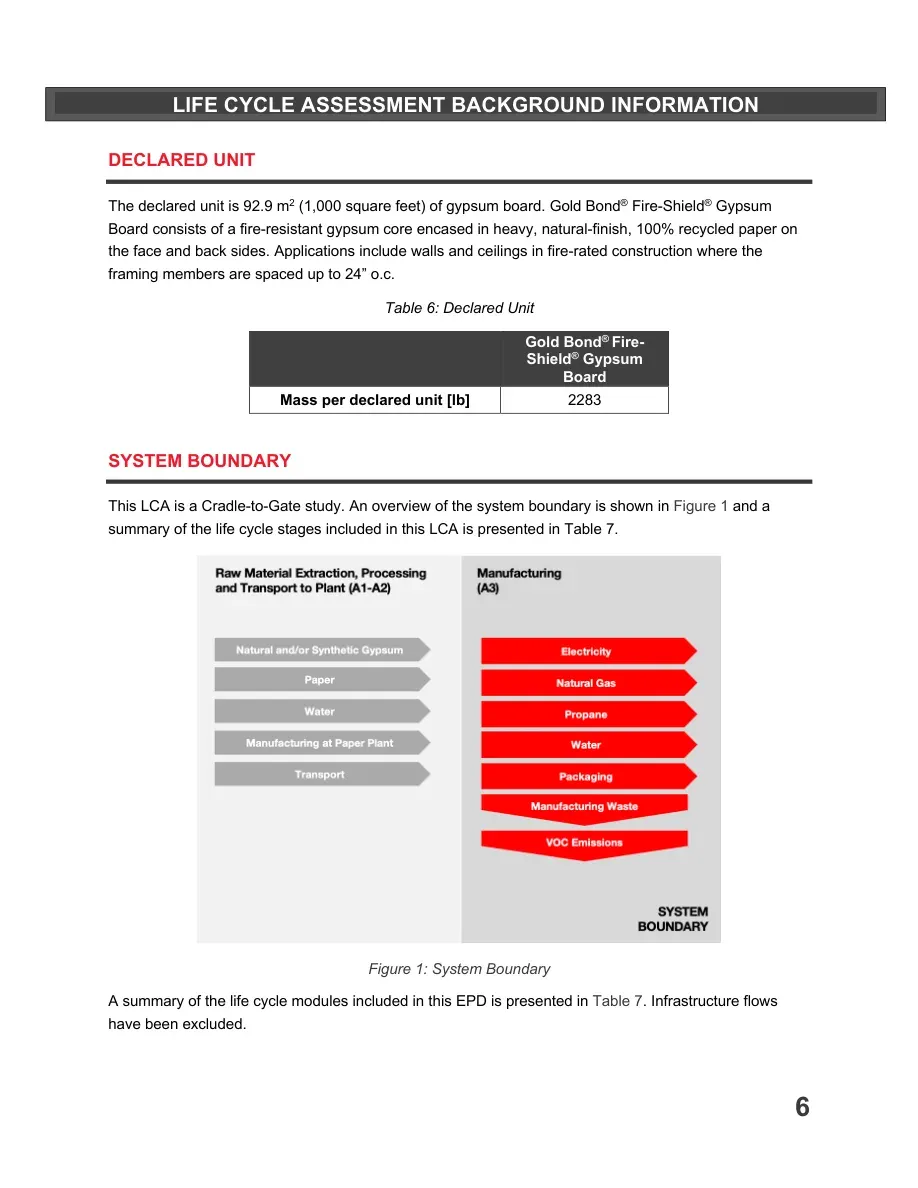
6 DECLARED UNIT The declared unit is 92.9 m2 (1,000 square feet) of gypsum board. Gold Bond® Fire-Shield® Gypsum Board consists of a fire-resistant gypsum core encased in heavy, natural-finish, 100% recycled paper on the face and back sides. Applications include walls and ceilings in fire-rated construction where the framing members are spaced up to 24” o.c. Table 6: Declared Unit Gold Bond® Fire-Shield® Gypsum Board Mass per declared unit [lb] 2283 SYSTEM BOUNDARY This LCA is a Cradle-to-Gate study. An overview of the system boundary is shown in Figure 1 and a summary of the life cycle stages included in this LCA is presented in Table 7. Figure 1: System Boundary A summary of the life cycle modules included in this EPD is presented in Table 7. Infrastructure flows have been excluded. LIFE CYCLE ASSESSMENT BACKGROUND INFORMATION
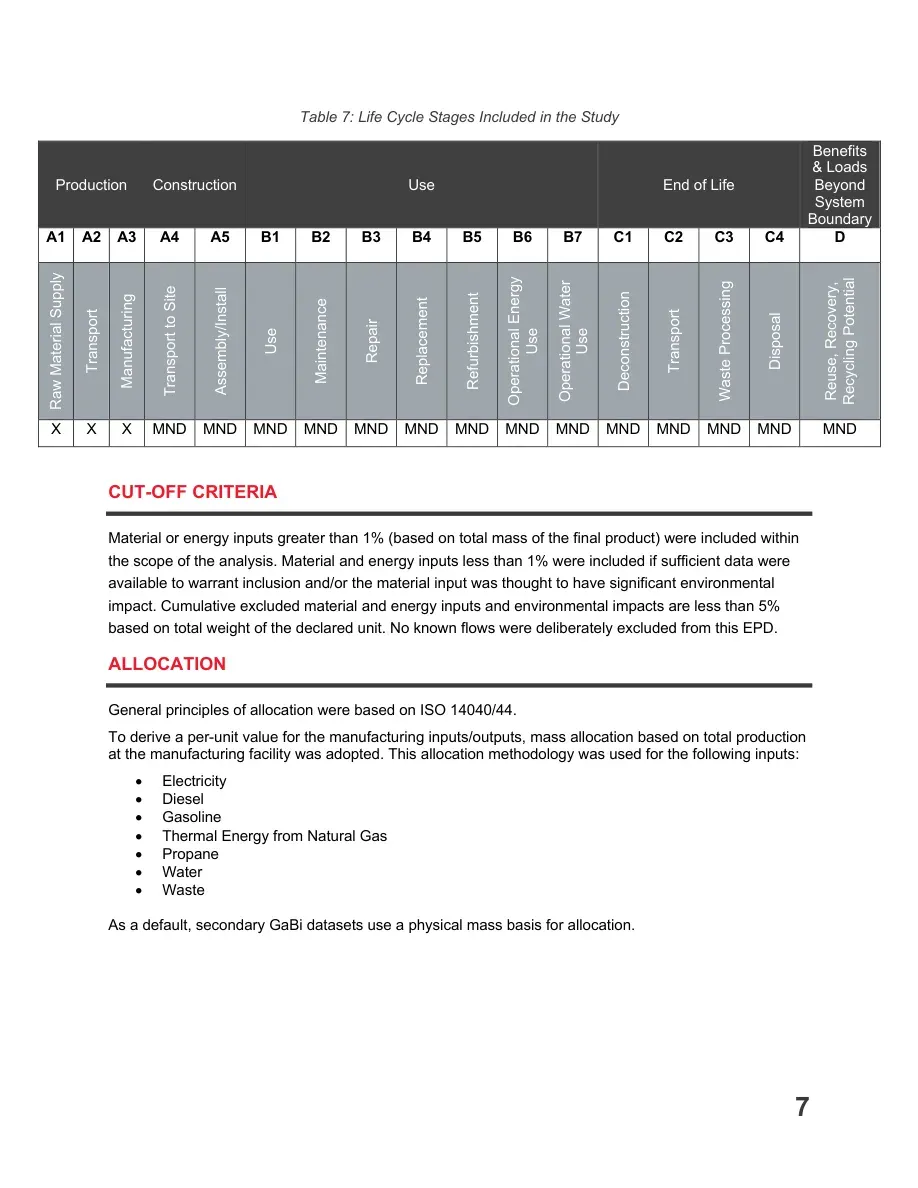
7 Table 7: Life Cycle Stages Included in the Study Production Construction Use End of Life Benefits & Loads Beyond System Boundary A1 A2 A3 A4 A5 B1 B2 B3 B4 B5 B6 B7 C1 C2 C3 C4 D Raw Material Supply Transport Manufacturing Transport to Site Assembly/Install Use Maintenance Repair Replacement Refurbishment Operational Energy Use Operational Water Use Deconstruction Transport Waste Processing Disposal Reuse, Recovery, Recycling Potential X X X MND MND MND MND MND MND MND MND MND MND MND MND MND MND CUT-OFF CRITERIA Material or energy inputs greater than 1% (based on total mass of the final product) were included within the scope of the analysis. Material and energy inputs less than 1% were included if sufficient data were available to warrant inclusion and/or the material input was thought to have significant environmental impact. Cumulative excluded material and energy inputs and environmental impacts are less than 5% based on total weight of the declared unit. No known flows were deliberately excluded from this EPD. ALLOCATION General principles of allocation were based on ISO 14040/44. To derive a per-unit value for the manufacturing inputs/outputs, mass allocation based on total production at the manufacturing facility was adopted. This allocation methodology was used for the following inputs: • Electricity • Diesel • Gasoline • Thermal Energy from Natural Gas • Propane • Water • Waste As a default, secondary GaBi datasets use a physical mass basis for allocation.
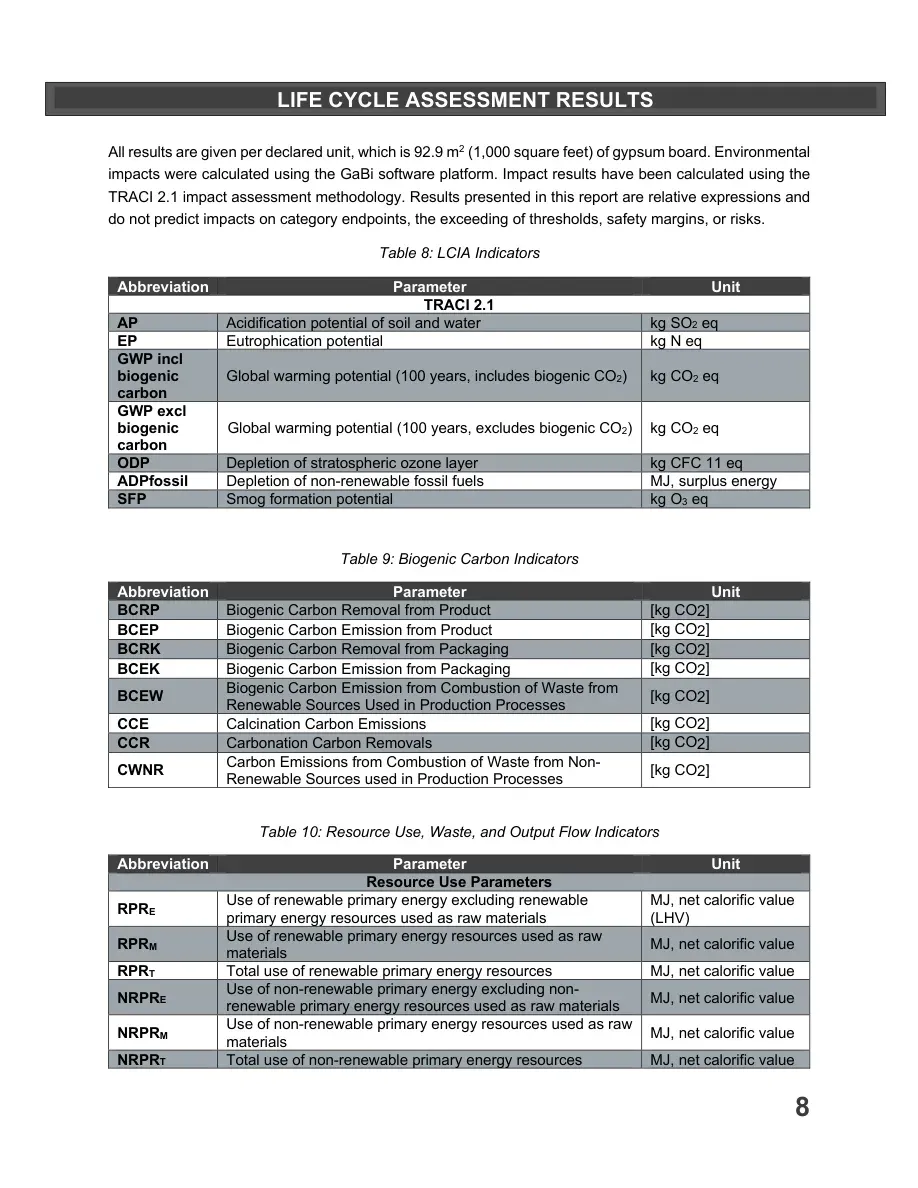
8 All results are given per declared unit, which is 92.9 m2 (1,000 square feet) of gypsum board. Environmental impacts were calculated using the GaBi software platform. Impact results have been calculated using the TRACI 2.1 impact assessment methodology. Results presented in this report are relative expressions and do not predict impacts on category endpoints, the exceeding of thresholds, safety margins, or risks. Table 8: LCIA Indicators Abbreviation Parameter Unit TRACI 2.1 AP Acidification potential of soil and water kg SO2 eq EP Eutrophication potential kg N eq GWP incl biogenic carbon Global warming potential (100 years, includes biogenic CO2) kg CO2 eq GWP excl biogenic carbon Global warming potential (100 years, excludes biogenic CO2) kg CO2 eq ODP Depletion of stratospheric ozone layer kg CFC 11 eq ADPfossil Depletion of non-renewable fossil fuels MJ, surplus energy SFP Smog formation potential kg O3 eq Table 9: Biogenic Carbon Indicators Abbreviation Parameter Unit BCRP Biogenic Carbon Removal from Product [kg CO2] BCEP Biogenic Carbon Emission from Product [kg CO2] BCRK Biogenic Carbon Removal from Packaging [kg CO2] BCEK Biogenic Carbon Emission from Packaging [kg CO2] BCEW Biogenic Carbon Emission from Combustion of Waste from Renewable Sources Used in Production Processes [kg CO2] CCE Calcination Carbon Emissions [kg CO2] CCR Carbonation Carbon Removals [kg CO2] CWNR Carbon Emissions from Combustion of Waste from Non- Renewable Sources used in Production Processes [kg CO2] Table 10: Resource Use, Waste, and Output Flow Indicators Abbreviation Parameter Unit Resource Use Parameters RPRE Use of renewable primary energy excluding renewable primary energy resources used as raw materials MJ, net calorific value (LHV) RPRM Use of renewable primary energy resources used as raw materials MJ, net calorific value RPRT Total use of renewable primary energy resources MJ, net calorific value NRPRE Use of non-renewable primary energy excluding non-renewable primary energy resources used as raw materials MJ, net calorific value NRPRM Use of non-renewable primary energy resources used as raw materials MJ, net calorific value NRPRT Total use of non-renewable primary energy resources MJ, net calorific value LIFE CYCLE ASSESSMENT RESULTS
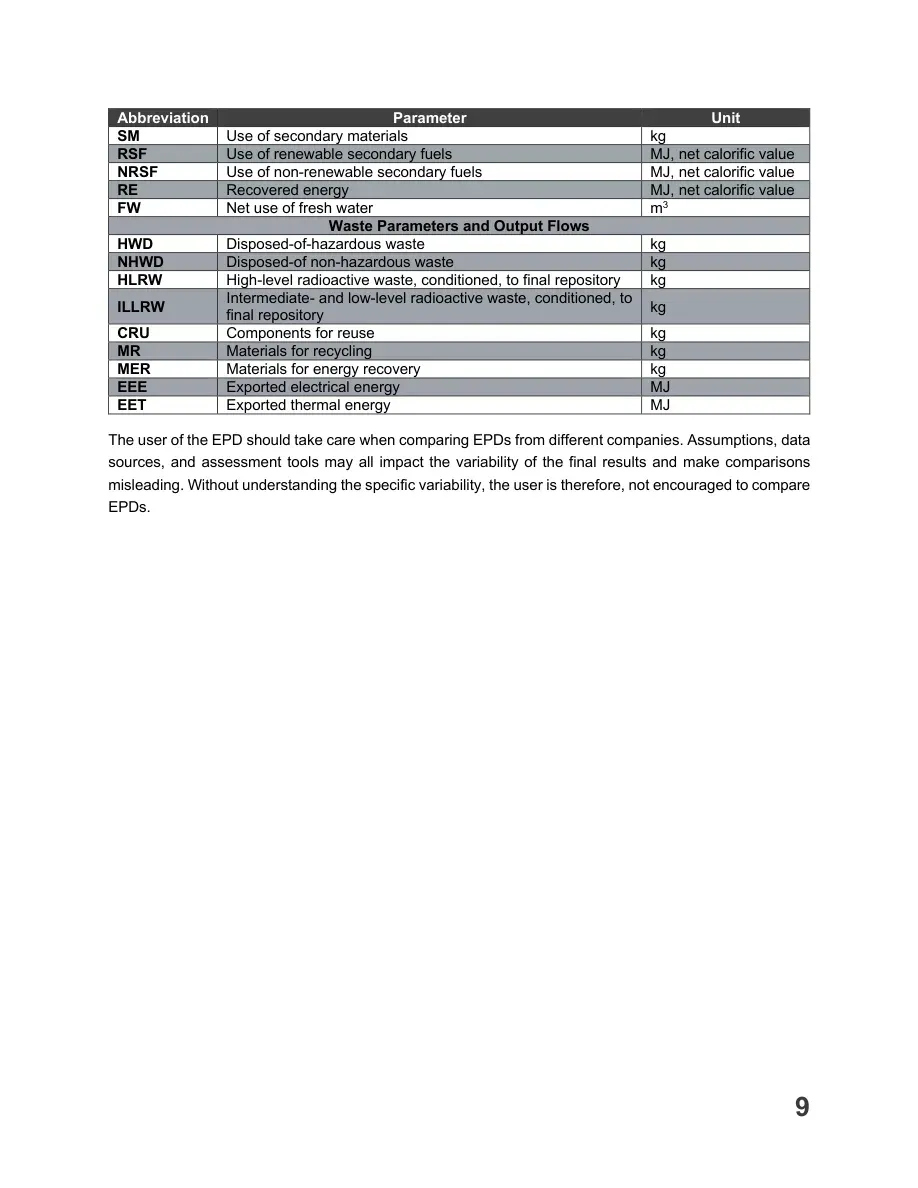
9 Abbreviation Parameter Unit SM Use of secondary materials kg RSF Use of renewable secondary fuels MJ, net calorific value NRSF Use of non-renewable secondary fuels MJ, net calorific value RE Recovered energy MJ, net calorific value FW Net use of fresh water m3 Waste Parameters and Output Flows HWD Disposed-of-hazardous waste kg NHWD Disposed-of non-hazardous waste kg HLRW High-level radioactive waste, conditioned, to final repository kg ILLRW Intermediate- and low-level radioactive waste, conditioned, to final repository kg CRU Components for reuse kg MR Materials for recycling kg MER Materials for energy recovery kg EEE Exported electrical energy MJ EET Exported thermal energy MJ The user of the EPD should take care when comparing EPDs from different companies. Assumptions, data sources, and assessment tools may all impact the variability of the final results and make comparisons misleading. Without understanding the specific variability, the user is therefore, not encouraged to compare EPDs.
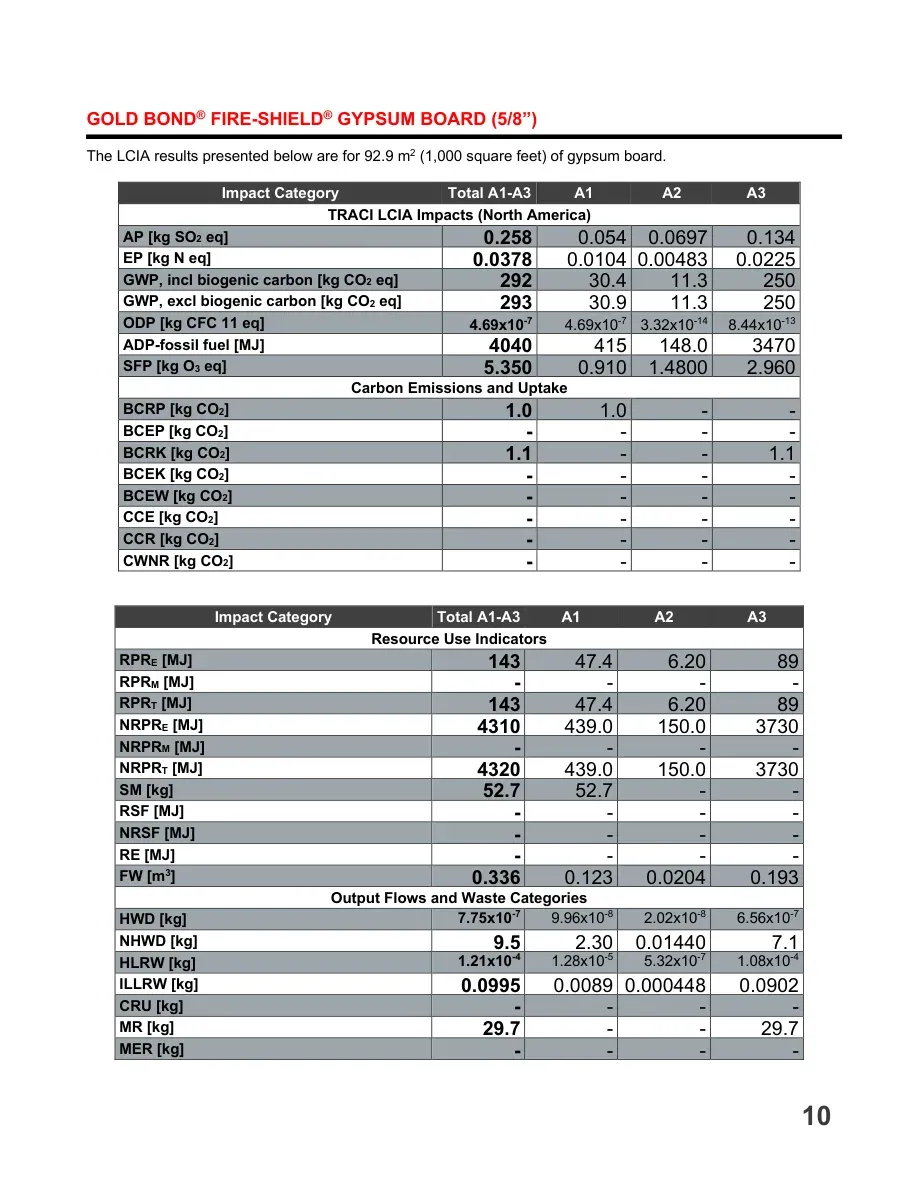
10 GOLD BOND® FIRE-SHIELD® GYPSUM BOARD (5/8”) The LCIA results presented below are for 92.9 m2 (1,000 square feet) of gypsum board. Impact Category Total A1-A3 A1 A2 A3 TRACI LCIA Impacts (North America) AP [kg SO2 eq] 0.258 0.054 0.0697 0.134 EP [kg N eq] 0.0378 0.0104 0.00483 0.0225 GWP, incl biogenic carbon [kg CO2 eq] 292 30.4 11.3 250 GWP, excl biogenic carbon [kg CO2 eq] 293 30.9 11.3 250 ODP [kg CFC 11 eq] 4.69x10⁻⁷ 4.69x10⁻⁷ 3.32x10⁻¹⁴ 8.44x10⁻¹³ ADP-fossil fuel [MJ] 4040 415 148.0 3470 SFP [kg O3 eq] 5.350 0.910 1.4800 2.960 Carbon Emissions and Uptake BCRP [kg CO2] 1.0 1.0 - - BCEP [kg CO2] - - - - BCRK [kg CO2] 1.1 - - 1.1 BCEK [kg CO2] - - - - BCEW [kg CO2] - - - - CCE [kg CO2] - - - - CCR [kg CO2] - - - - CWNR [kg CO2] - - - - Impact Category Total A1-A3 A1 A2 A3 Resource Use Indicators RPRE [MJ] 143 47.4 6.20 89 RPRM [MJ] - - - - RPRT [MJ] 143 47.4 6.20 89 NRPRE [MJ] 4310 439.0 150.0 3730 NRPRM [MJ] - - - - NRPRT [MJ] 4320 439.0 150.0 3730 SM [kg] 52.7 52.7 - - RSF [MJ] - - - - NRSF [MJ] - - - - RE [MJ] - - - - FW [m3] 0.336 0.123 0.0204 0.193 Output Flows and Waste Categories HWD [kg] 7.75x10⁻⁷ 9.96x10⁻⁸ 2.02x10⁻⁸ 6.56x10⁻⁷ NHWD [kg] 9.5 2.30 0.01440 7.1 HLRW [kg] 1.21x10⁻⁴ 1.28x10⁻⁵ 5.32x10⁻⁷ 1.08x10⁻⁴ ILLRW [kg] 0.0995 0.0089 0.000448 0.0902 CRU [kg] - - - - MR [kg] 29.7 - - 29.7 MER [kg] - - - -
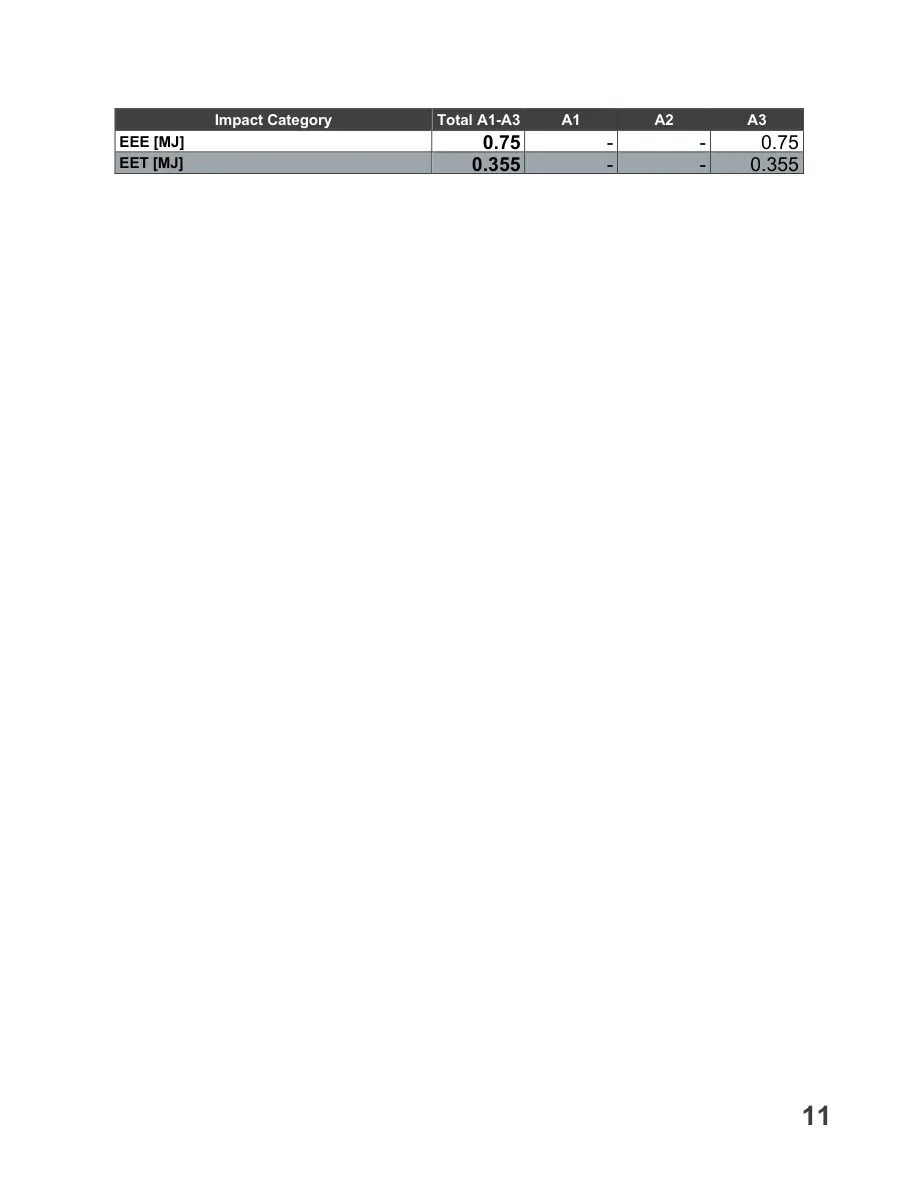
11 Impact Category Total A1-A3 A1 A2 A3 EEE [MJ] 0.75 - - 0.75 EET [MJ] 0.355 - - 0.355
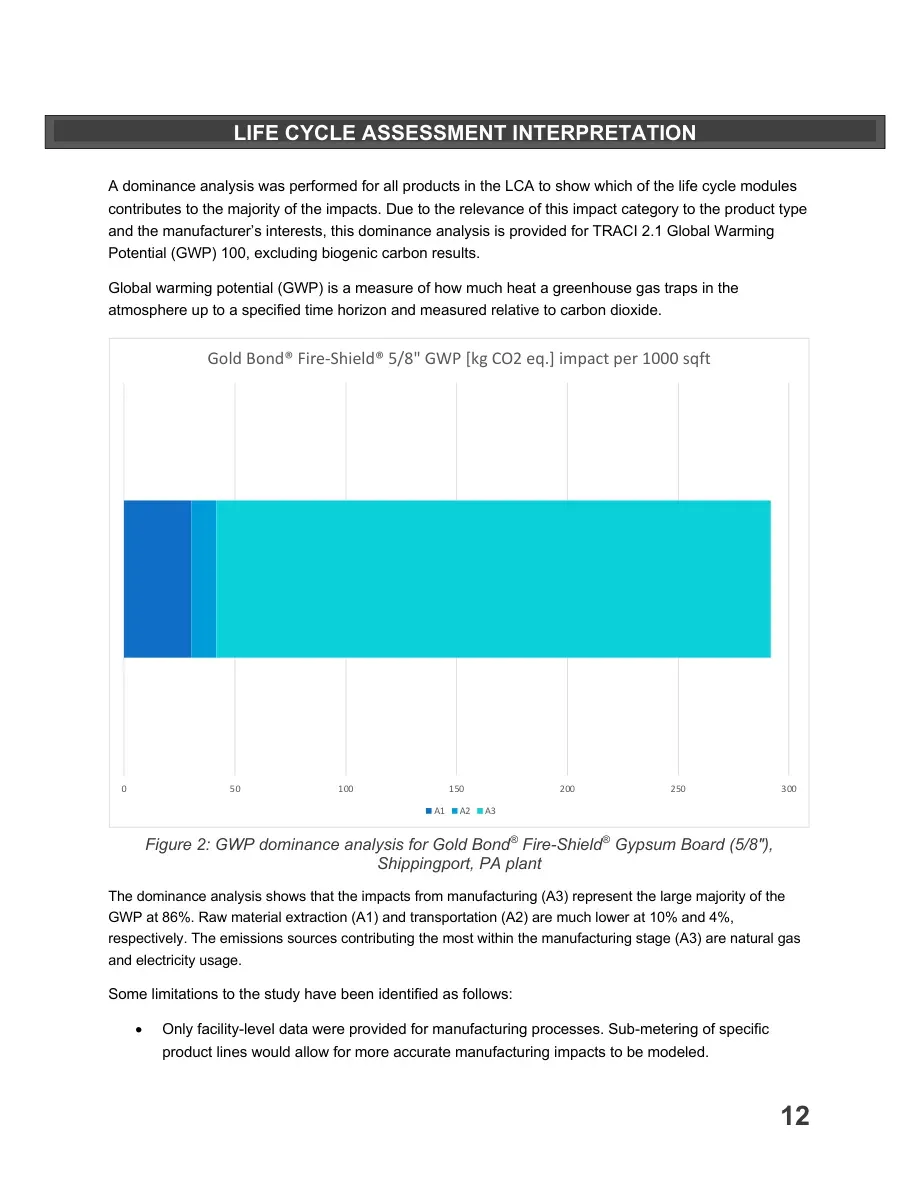
12 A dominance analysis was performed for all products in the LCA to show which of the life cycle modules contributes to the majority of the impacts. Due to the relevance of this impact category to the product type and the manufacturer’s interests, this dominance analysis is provided for TRACI 2.1 Global Warming Potential (GWP) 100, excluding biogenic carbon results. Global warming potential (GWP) is a measure of how much heat a greenhouse gas traps in the atmosphere up to a specified time horizon and measured relative to carbon dioxide. Figure 2: GWP dominance analysis for Gold Bond® Fire-Shield® Gypsum Board (5/8"), Shippingport, PA plant The dominance analysis shows that the impacts from manufacturing (A3) represent the large majority of the GWP at 86%. Raw material extraction (A1) and transportation (A2) are much lower at 10% and 4%, respectively. The emissions sources contributing the most within the manufacturing stage (A3) are natural gas and electricity usage. Some limitations to the study have been identified as follows: • Only facility-level data were provided for manufacturing processes. Sub-metering of specific product lines would allow for more accurate manufacturing impacts to be modeled. 050100150200250300Gold Bond® Fire-Shield® 5/8" GWP [kg CO2 eq.] impact per 1000 sqftA1A2A3LIFE CYCLE ASSESSMENT INTERPRETATION
13 • Availability of geographically more accurate datasets would have improved the accuracy of the study. • Since this LCA uses the cut-off approach to model recycled material in the product, no credit is given to the product system. Instead, the manufacturer realizes reduced environmental impacts through the absence of the burden of extracting virgin material. • Only known and quantifiable environmental impacts are considered. • Due to the assumptions and value choices listed above, these do not reflect real-life scenarios and hence they cannot assess actual and exact impacts, but only potential environmental impacts. ENVIRONMENTAL ACTIVITIES AND CERTIFICATIONS Gold Bond® Fire-Shield® Gypsum Board is UL GREENGUARD Gold certified and has a published Health Product Declaration. Gypsum boards, if installed and treated properly, will last the lifetime of the building. ADDITIONAL ENVIRONMENTAL INFORMATION
14 1. Life Cycle Assessment, LCA Report for National Gypsum Company – Gypsum Boards. WAP Sustainability Consulting. August 2024. 2. NSF Product Category Rule (PCR) for Gypsum Panel Products Version 1.1 (April 2020) 3. ISO 14044: 2006 Environmental Management – Life cycle assessment – Requirements and Guidelines. 4. ISO 14044: 2006/ Amd 1:2017 Environmental Management – Life cycle assessment – Requirements and Guidelines – Amendment 1. 5. ISO 14025:2006 Environmental labels and declarations – Type III environmental declarations – Principles and Procedures. 6. ISO 21930:2017 Sustainability in buildings and civil engineering works – Core rules for environmental product declarations of construction products and services. REFERENCES